Zoe Kravitz has married at her father’s home in Paris, France. Read More
from Canoe https://ift.tt/2Nl5nM8

Black Mag Would you like to share your story, your advice or your lessons in life with over 3 million monthly readers of blackmag.tk?
Sunday, 30 June 2019
Princess Diana’s ‘favourite sweater’ to fetch thousands at auction
A sweater once owned by British royal Princess Diana is expected to make US$5,078 when it goes up for auction. Read More
from Canoe https://ift.tt/2IYgAOl
from Canoe https://ift.tt/2IYgAOl
Andy Cohen’s baby son helping Anderson Cooper mourn late mother
Andy Cohen’s four-month-old son is proving a great distraction for TV anchor Anderson Cooper following his beloved mother’s passing. Read More
from Canoe https://ift.tt/32162Wd
from Canoe https://ift.tt/32162Wd
Former PM Harper offers help on trade, but staying ’neutral’ in UK Tory race
Former prime minister Stephen Harper says he's willing to help the next British prime minister negotiate a divorce deal with the European Union -- but he's not taking sides in the race to decide who that is. Read More
from Canoe https://ift.tt/2NnBBpW
from Canoe https://ift.tt/2NnBBpW
Ontario community sets Guinness World Record for largest human maple leaf
TRENTON, Ont. -- An Ontario municipality now has bragging rights after setting the record for the largest human maple leaf over the Canada Day long weekend. Read More
from Canoe https://ift.tt/324m8hR
from Canoe https://ift.tt/324m8hR
What’s in a name? How Canada’s national birthday as we know it came to be
Many hail July 1 as Canada Day, others may hearken back to when the nation's birthday was labelled Dominion Day, and some may wish to ignore it altogether, just like those who refused to celebrate the country's founding for the first dozen years of its existence. Read More
from Canoe https://ift.tt/2Xi2Iav
from Canoe https://ift.tt/2Xi2Iav
Rare juvenile sixgill shark sighting off Vancouver is good news for population
VANCOUVER -- A rare encounter with several juvenile bluntnose sixgill sharks in waters off Vancouver implies the population may be larger than previously thought, says a marine biologist. Read More
from Canoe https://ift.tt/2XidfCx
from Canoe https://ift.tt/2XidfCx
Brampton man, 37 dies in Lake Muskoka swimming incident
GRAVENHURST, Ont. -- Provincial police are investigating a possible drowning at a public beach on Lake Muskoka in Gravenhurst, Ont. Read More
from Canoe https://ift.tt/2Jdi1rp
from Canoe https://ift.tt/2Jdi1rp
Hong Kong prepares for pro-democracy march amid extradition bill anger
HONG KONG -- Hong Kong authorities called for calm ahead of Monday's annual pro-democracy march, with widespread anger over an extradition bill expected to lead to large crowds after high-profile protests this month against the proposal. Read More
from Canoe https://ift.tt/2X7VG3i
from Canoe https://ift.tt/2X7VG3i
A Zoo In Japan Used Someone In A Lion Costume As Prep Should A Real Big Cat Ever Escape

A zoo in Japan has been using a rather novel way of preparing their staff for a potential lion attack, by having one of them dress up as one.
Zoos are controversial places. For some, they are the perfect place to spend the day with the family. The chance to see exotic animals from far away places. Plus, most important of all, in most cases they are establishments that protect animals. If zoos didn't exist, it's entirely possible that some species of animal would be extinct.
Others see zoos as animal prisons. Places we have created so we can ogle at animals for our own pleasure. In extremely rare cases, those "imprisoned" animals manage to break free from their enclosures. That can naturally cause a state of panic within the zoo, and most people would not know what to do.
RELATED: African Wildlife Park Goes Entire Year Without An Elephant Being Poached
Tobe Zoo has taken steps to ensure its staff knows exactly what to do should some of its most dangerous residents escape. However, we're not entirely sure how prepared they will be should it happen. The zoo's bizarre training drill revolved around one of its employees dressing up as a lion and prowling around the zoo grounds, on two feet no less. You'd have thought they would at least crawl around on all fours.
The fact that this particular lion is a biped is by no means the strangest and funniest part of this training routine. As a group of zookeepers closes in on the "escaped" predator with a giant net, it chooses to body check one of its captors, knocking them to the floor. Our favorite part? When the footage cuts to two real-life lions watching on, clearly wondering why humans are so stupid.
The training comes to an end with some sort of weird drive by. A white van shows up with what we're assuming is a tranquilizer gun pointed out the back window. After being hit with a dart, the big cat falls to the floor. The keepers in the van then proceed to use a really big stick to prod their lion-clad employee. Should a real lion escape its enclosure at Tobe Zoo, there's no doubt in our minds that these men and women are now fully equipped to handle it.
NEXT: Get To Grips With The Science Behind Avengers: Endgame
from TheRichest - Feed https://ift.tt/2J0lzOP
Trump holds historic meeting with Kim with a tweet, handshake and ‘flowers of hope’
PANMUNJOM -- U. S. President Donald Trump took a historic step into North Korea on Sunday, drawing on his penchant for showmanship and surprise to pull off talks with Kim Jong Un in the Demilitarized Zone (DMZ) that divides the two Koreas. Read More
from Canoe https://ift.tt/2FHxvTE
from Canoe https://ift.tt/2FHxvTE
Motel 6 hotel chain to settle lawsuit over sharing guest lists with ICE
Motel 6 has agreed to pay $10 million to settle a class-action lawsuit over claims the budget chain routinely provided guest lists from properties in Arizona to U.S. Immigration and Customs Enforcement (ICE) agents, court documents showed on Saturday. Read More
from Canoe https://ift.tt/2KPwbSL
from Canoe https://ift.tt/2KPwbSL
Joe Jonas, Sophie Turner tie knot in second wedding
Joe Jonas and Sophie Turner have married for a second time. Read More
from Canoe https://ift.tt/2YnzYcS
from Canoe https://ift.tt/2YnzYcS
Report: Kyrie Irving, Brooklyn Nets near four-year, $141M deal
The Brooklyn Nets and former Boston Celtics guard Kyrie Irving are "motivated to move quickly toward" on a four-year, $141 million deal when they meet in New York on Sunday shortly after the beginning of free agency, ESPN reported Saturday. Read More
from Canoe https://ift.tt/2XjDbOf
from Canoe https://ift.tt/2XjDbOf
Reports: Kemba Walker to sign four-year, $141M deal with Celtics
Three-time All-Star Kemba Walker will be in Boston on Sunday to confirm his agreement to join the Celtics on a four-year, $141 million deal, according to multiple reports. Read More
from Canoe https://ift.tt/2Xb9f1S
from Canoe https://ift.tt/2Xb9f1S
Quebecers less exposed to Holocaust than other Canadians, poll finds
MONTREAL -- A new poll suggests that Quebecers are significantly less likely than other Canadians to have learned about the Holocaust in school or read a book about the Second World War genocide. Read More
from Canoe https://ift.tt/2IYMGtF
from Canoe https://ift.tt/2IYMGtF
‘I WAS VERY, VERY NERVOUS’: Red Sox, Yankees enjoy pregame royal visit
Prince Harry and his American-born wife, Meghan Markle, stopped into the clubhouses of the New York Yankees and Boston Red Sox before the two rivals took the field in London. Read More
from Canoe https://ift.tt/2YnGDnq
from Canoe https://ift.tt/2YnGDnq
Still-life painting looted by Nazis to return to Florence
MILAN -- A still-life painting by the Dutch master Jan van Huysum which was looted by retreating Nazi troops in World War Two will be returned to Florence, the Italian government said on Saturday. Read More
from Canoe https://ift.tt/2IXs0Su
from Canoe https://ift.tt/2IXs0Su
Woman arrested after LGBTQ group protests at Hamilton mayor’s house
Hamilton police say they've made an arrest after a group of LGBTQ demonstrators showed up at the mayor's house Friday morning. Read More
from Canoe https://ift.tt/2LrjFID
from Canoe https://ift.tt/2LrjFID
Putin says ‘genius musician’ Elton John mistaken on Russia LGBT rights
OSAKA -- Russian President Vladimir Putin said on Saturday that Elton John was "mistaken" about LGBT rights in Russia, while praising the British singer as a musical genius. Read More
from Canoe https://ift.tt/302ekeX
from Canoe https://ift.tt/302ekeX
Wildfires and power cuts plague Europeans as heatwave breaks records
PARIS/MADRID -- Hundreds of firefighters brought wildfires under control in southern France on Saturday as a stifling heatwave brought record-breaking temperatures to parts of Europe, killing at least six people. Read More
from Canoe https://ift.tt/2IXDKV7
from Canoe https://ift.tt/2IXDKV7
Saturday, 29 June 2019
At G20, Trudeau highlights plight of Canadians in China, but details scarce
OSAKA, Japan -- Justin Trudeau kept his cards close to the vest Saturday as he wrapped up this weekend's high-stakes G20 meetings in Japan, acknowledging Canada's protracted impasse with China but offering few details about the ongoing effort to liberate the two Canadians caught in the crossfire. Read More
from Canoe https://ift.tt/2Jidl3d
from Canoe https://ift.tt/2Jidl3d
Ex-senator Don Meredith harassed staff, constable, ethics officer reports
OTTAWA -- The Senate's ethics officer says ex-senator Don Meredith created a poisoned work environment by harassing a half-dozen employees, plus a constable in the upper chamber's protection service. Read More
from Canoe https://ift.tt/2ZXVaH2
from Canoe https://ift.tt/2ZXVaH2
New Trudeau-Trump opioid plan helps rebuild frayed relations from trade talks
OTTAWA -- The ranking U.S. diplomat on drug enforcement policy is to visit Ottawa in July to kick-start a fresh round of co-operation between the two countries on tackling the opioid crisis. Read More
from Canoe https://ift.tt/2X9e9MZ
from Canoe https://ift.tt/2X9e9MZ
Garbage-hauling ship arrives in Canada after journey from Philippines
VANCOUVER -- A ship carrying an infamous load of Canadian trash that had been rotting in the Philippines since as far back as 2013 has arrived at a port south of Vancouver. Read More
from Canoe https://ift.tt/2Yp0gf8
from Canoe https://ift.tt/2Yp0gf8
Take A Look Around The Obamas' Luxury French Vacation Destination

Barack Obama and his family recently took a vacation to France, and the place they stayed is pretty spectacular.
Holidays and vacations mean something different to all of us. Some like nothing more than to retire to a quiet coastal destination and spend a week on the beach. Others prefer to keep busy during their time off, perhaps on a city break to explore somewhere they have never been before. For the rich and famous, it might not be as simple as that.
The idea of wandering around a busy city when you have a face that is known around the world doesn't sound much like a holiday if you ask us. That's why when Barack and Michelle Obama want to get away from it all, the place they choose to go has to be pretty secluded. Obama might not be the President of the United States any longer, but he will still be instantly recognized by almost everyone who sees him.
RELATED: Millionaire Shares What He Regrets Spending Money On In His 20s
If we have now left you pondering where in the world the Obamas could possibly go to escape it all, then wonder no more. Barack and his family reportedly went on vacation to France last week, and stayed in a small town called Avignon, reports CNBC. More specifically, a vacation rental called Le Mar des Poiriers.
As you can see, the nine-bedroom farmhouse is pretty remarkable. It is split into a main seven-bedroom house and a two-bedroom cottage. It has its own gym, swimming pool, tennis court, and even comes with two chefs and two waiters so that those who stay there don't need to lift a finger, at least not at meal times.
Since its a rental, Le Mar des Poiriers is available for anyone to stay in. It will cost you a pretty penny, though, as you might have already guessed. €55,000 per week to be exact, or around $62,500. Perhaps if you have enough friends to put two people in each bedroom and split the cost it wouldn't be so bad. Or you know, became the President of the United States as clearly the job pays pretty well.
NEXT: Get To Grips With The Science Behind Avengers: Endgame
from TheRichest - Feed https://ift.tt/2RLe54N
Kawhi Leonard wants Magic Johnson to be at Lakers meeting: report
Magic Johnson is no longer working for the Los Angeles Lakers, but apparently not everyone is willing to deal with the club without him. Read More
from Canoe https://ift.tt/2XEIc3k
from Canoe https://ift.tt/2XEIc3k
Lady Gaga fires up LGBTQ rally for Stonewall anniversary in New York City
NEW YORK – Lady Gaga electrified thousands of revelers who gathered in New York on Friday to celebrate the 50th anniversary of the LGBTQ rights movement, exhorting the crowd to honour the past by using its "power" to extend and defend a half-century of progress. Read More
from Canoe https://ift.tt/2RHwP5n
from Canoe https://ift.tt/2RHwP5n
Alabama prosecutors weigh manslaughter indictment of woman who lost fetus in shooting
Eight weeks after an Alabama grand jury indicted a woman for manslaughter over the loss of her fetus in a shooting she was accused of provoking, a state district attorney's office said on Friday it was still considering whether to prosecute the case. Read More
from Canoe https://ift.tt/2XGGKNT
from Canoe https://ift.tt/2XGGKNT
Donald Trump to discuss Huawei during highly-anticipated meeting with Chinese president
OSAKA, Japan — U.S. President Donald Trump says he will discuss Huawei during a meeting with Chinese President Xi Jinping. Read More
from Canoe https://ift.tt/2X4PKIk
from Canoe https://ift.tt/2X4PKIk
R. Kelly seeks sex abuse lawsuit dismissal
R. Kelly's lawyers are seeking the dismissal of a civil suit filed against the troubled singer by one of his sex abuse accusers. Read More
from Canoe https://ift.tt/2XicQQD
from Canoe https://ift.tt/2XicQQD
Fans invited to public memorial for Beth Chapman
Fans of late reality TV star Beth Chapman have been invited to join her family and friends at a public memorial on Saturday. Read More
from Canoe https://ift.tt/2Jbp5Vo
from Canoe https://ift.tt/2Jbp5Vo
Friday, 28 June 2019
Allison Williams and husband split
Get Out star Allison Williams and her husband have split after four years of marriage. Read More
from Canoe https://ift.tt/2ZRi4Qj
from Canoe https://ift.tt/2ZRi4Qj
Ex Guns N’ Roses drummer Steven Adler hospitalized after possible suicide attempt
Former Guns N’ Roses drummer Steven Adler was hospitalized on Thursday night after allegedly stabbing himself in the stomach. Read More
from Canoe https://ift.tt/2YlX2ZM
from Canoe https://ift.tt/2YlX2ZM
Micron: Shipments of 3D QLC for SSDs Nearly Double QoQ as Wafer Starts Cut Again

Micron was among the first companies to start mass production and shipments of 3D QLC NAND, so it is not surprising that at present it is among the leading suppliers of such flash memory as well as products on its base. According to the company’s management, bit shipments of 3D QLC for SSDs almost doubled quarter-over-quarter.
Micron uses its 3D QLC NAND for a number of products, including NVMe and SATA SSDs for clients and servers as well as microSD memory cards. In addition, Micron sells 3D QLC to other suppliers of SSDs. Since per-GB pricing of 3D QLC flash memory is very competitive against 3D MLC and 3D TLC, drives featuring this type of NAND are priced very reasonably, which makes them popular among end users. Considering this, it is not surprising that shipments of Micron’s 3D QLC memory for SSDs have increased 75% quarter-over-quarter.
“QLC SSD bit shipments increased approximately 75% sequentially, driven by growth of our consumer NVMe SSDs,” said Sanjay Mehrotra, CEO of Micron.
According to estimates by SK Hynix, TLC NAND accounts for 85% of the NAND flash market today, so it will take 3D QLC quite some time to challenge the proven type of memory in terms of bit shipments.
Micron admits that supply of 3D NAND continues to exceed demand, which negatively affects pricing from a supplier perspective. Transition to 96-layer 3D NAND as well as to 3D QLC memory will inevitably increase the supply of flash in terms of total bit capacity. To that end, Micron plans to further adjust production of NAND in the coming quarter, but it remains to be seen whether this will help as the company will be cutting production (among other things) of its prior-generation NAND devices.
“Since our last earnings call, we have taken actions to further adjust wafer starts from the previously announced 5% reduction to now approximately 10%, which will result in lower supply growth in the second half of the calendar year,” said Mr. Mehrotra.
Related Reading:
- Micron Returns to the microSD Card Market with the Micron c200 Series: From 128 GB to 1 TB
- Micron Introduces 2200 Client NVMe SSD With New In-House Controller
- The Crucial P1 1TB SSD Review: The Other Consumer QLC SSD
- Micron Non-Volatile Update (Q2'18): 96L 3D NAND in H2, 4th Gen 3D NAND Enroute, Sales of 3D XPoint Disappoint
- Micron’s 96-Layer 3D TLC NAND Demonstrated, Qualified by Maxio, SMI
- Boom to Bust: Memory Makers Plan to Cut NAND Flash Production
Source: Micron


from AnandTech https://ift.tt/2JactOn
Germany’s largest online drugs dealer shut down, 11 arrested
BERLIN -- Authorities shut down Germany's largest online wholesaler of illegal drugs and arrested 11 people as part of an international investigation into a drugs ring they said spanned five European countries and sold narcotics worldwide. Read More
from Canoe https://ift.tt/2KIDJ9V
from Canoe https://ift.tt/2KIDJ9V
Supreme Court orders new trial over use of sexual history in Edmonton case
OTTAWA -- Canada's top court says an Edmonton man shouldn't have been able to tell a jury that he was in a "friends-with-benefits" relationship with an alleged sexual assault victim. Read More
from Canoe https://ift.tt/2Nu8xxo
from Canoe https://ift.tt/2Nu8xxo
Micron’s DRAM Update: More Capacity, Four More 10nm-Class Nodes, EUV, 64 GB DIMMs
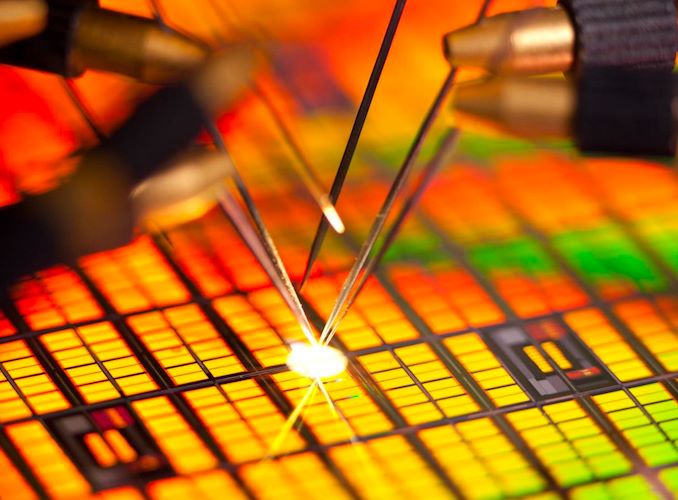
During its earnings conference call with investors and financial analysts earlier this week, Micron expressed confidence in its long-term future and strong demand for its products as new applications emerge in various fields in the coming years. The company also outlined its plans to expand capacities and rapidly shift to more advanced process technologies.
“We are confident that the long-term demand outlook for memory and storage is compelling, driven by broad secular trends such as AI, autonomous vehicles, 5G, and IoT,” said Sanjay Mehrotra, CEO of Micron. “The new Micron is well positioned to take advantage of these trends, with innovative products, a responsive supply chain, and well-established relationships with customers worldwide.”
Prices of DRAM have declined rather dramatically in the recent quarters as supply exceeds demand. To cut down on costs and to prepare for the emergence of new applications that will need memory, DRAM makers are aggressively transitioning to newer process technologies. Meanwhile, while admitting that they need to balance DRAMs supply and demand, they actually set up aggressive plans for expansion for their production capacities because they need more cleanroom space for upcoming manufacturing technologies.
Micron has an aggressive roadmap when it comes to fabrication proceses that includes four more 10 nm-class nodes (i.e., for a total of six 10 nm class technologies), and the company is researching an eventual transition to extreme ultraviolet lithography (EUVL). That being said, the company is also expanding its production capacities in a bid to produce next-gen memories for next-gen applications. The company is currently exploiting the fruits of its latest process technology by preparing 32 GB memory modules for client systems as well as 64 GB DIMMs for servers.

from AnandTech https://ift.tt/2ZV8TOC
Sotheby’s auction may make NASA intern with rare Neil Armstrong’s moon walk videotape a millionaire
A one-time NASA intern who bought a truckload of videotapes to resell them may end up a millionaire next month when Sotheby's auctions what it says is the only surviving original recording of man's first steps on the moon 50 years ago. Read More
from Canoe https://ift.tt/2NjRUo1
from Canoe https://ift.tt/2NjRUo1
Life sentence sought for neo-Nazi who killed protester at white supremacist rally
The self-described neo-Nazi convicted of killing Heather Heyer by ramming his car into a crowd protesting a white supremacist rally in Charlottesville, Virginia in 2017 will learn on Friday whether he will spend the rest of his life in prison. Read More
from Canoe https://ift.tt/2FDUlvf
from Canoe https://ift.tt/2FDUlvf
France braces for record 45C as Europe melts
PARIS/MADRID -- France steeled itself on Friday for its hottest day since records began as the death toll rose from a heatwave suffocating swathes of Europe. Read More
from Canoe https://ift.tt/2KJBp2g
from Canoe https://ift.tt/2KJBp2g
In The Lab: MSI X570 Motherboard Preview with the Godlike and Ace
The next generation of AMD Ryzen 3000 processors is edging closer to being released, and we'll see the results on July 7th. But alongside the new 7 nm processors we have a brand new motherboard chipset. As we receive copious amounts of deliveries containing new X570 models from various vendors, the first to arrive in my hands is MSI's high-end pairing from the MEG series, the MSI MEG X570 Godlike and the MEG X570 Ace.

from AnandTech https://ift.tt/321rMSa
Innodisk Unveils Fire Shield SSD: Withstands 800°C Temperature & Direct Flames

Innodisk has introduced its new storage device that can withstand extreme temperatures as well as direct fire. The Fire Shield SSD can be used as a ‘Black Box’ device for in-vehicle and other applications that need ultra-reliable storage for accident investigations and other matters.
Set to be available in a 3.5-inch form-factor, Innodisk’s Fire Shield SSD is rated to survive temperatures of up to 800°C as well as direct exposure to flames for up to 30 minutes retaining 100% of the data it stores.
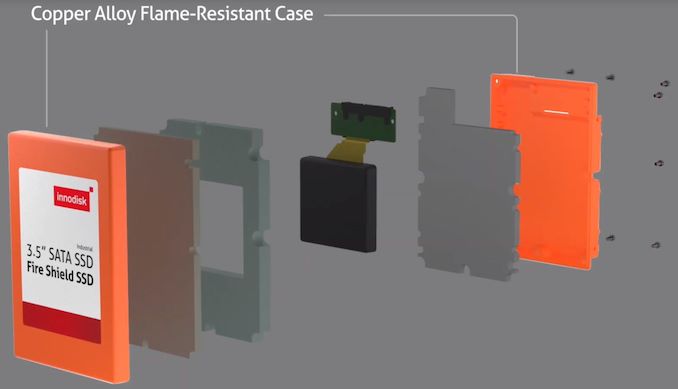
The drive comes in a special chassis that features three layers of protection against drops, fire, extreme temperatures, and so on. The enclosure of the SSD is made of a special copper-based alloy that is resistant to flames. Inside, there is another casing made of a heat-isolating lining material that is also used to firmly hold the drive in its position inside the chassis. The drive is then housed in a yet another protective chassis. The SSD itself is a small unit that is attached to external SATA ports using a special flexible connector that burns down quickly at low temperatures and thus does not transfer heat from the outside to the PCB of the storage device.
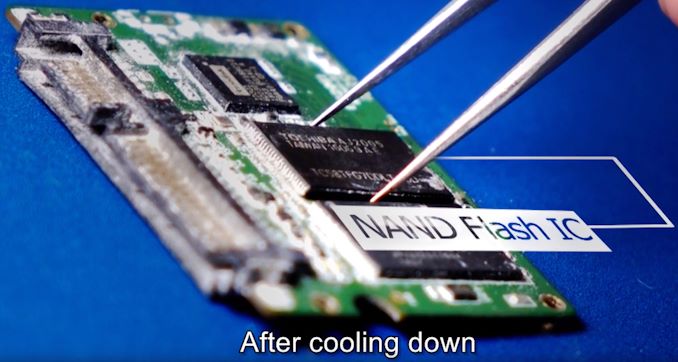
Fire Shield SSDs from Innodisk will feature a SATA interface and will be based on SLC or iSLC NAND flash memory for maximum performance and endurance. The manufacturer makes no secret that because of its construction after a long exposure to fire, its Fire Shield SSD cannot be used right away. Instead, a specialist will have to extract memory chips and read them using a special recovery device.

Innodisk does not mention pricing of its Fire Shield SSDs and currently does not list the product on its website. Given very specific positioning of the drive, it is likely that it will be built-to-order and its price will depend on volumes and configurations.
Related Reading:
- Innodisk Launches M.2 Graphics Card with 4K Output
- CRU Acquires ioSafe, Creating Disaster-Resistant Storage Powerhouse
- ioSafe Launches BDR 515 Backup and Disaster Recovery Appliance
- Averting Disaster - A Guide To Computer Backups (2014)
Source: Innodisk
from AnandTech https://ift.tt/2YlkMNs
Poll finds the things Canadians are most proud of
More Canadians take pride in the things that affect them today than they do in their country's history, a survey from the Association for Canadian Studies suggests. Read More
from Canoe https://ift.tt/2LsMPXJ
from Canoe https://ift.tt/2LsMPXJ
‘Don’t meddle in the election, please,’ Trump sardonically asks Putin at G20 meeting
OSAKA -- President Donald Trump on Friday sardonically asked his Russian counterpart to please not meddle in U.S. elections, appearing to make light of a scandal that led to an investigation of his campaign's contact with the Kremlin during 2016 elections. Read More
from Canoe https://ift.tt/2YkrMKz
from Canoe https://ift.tt/2YkrMKz
Nipsey Hussle and accused killer talked about snitching: Reports
Rapper Nipsey Hussle and the man accused of killing him talked about "snitching" before the rap star was shot dead, according to court documents released Thursday, media reports said. Read More
from Canoe https://ift.tt/2NhBhZW
from Canoe https://ift.tt/2NhBhZW
How Canadian is this, eh? Saskatoon man buys $777 canoe with Canadian Tire money
SASKATOON -- You can't get much more Canadian than buying a canoe with a briefcase full of Canadian Tire money. Read More
from Canoe https://ift.tt/2XatLER
from Canoe https://ift.tt/2XatLER
Kamal Harris goes after Joe Biden on race in U.S. presidential debate
MIAMI — Democratic presidential candidate Kamala Harris confronted front-runner Joe Biden on race during a debate on Thursday, saying Biden's remarks about working with pro-segregationist senators were "hurtful" and questioning his 1970s opposition to school busing. Read More
from Canoe https://ift.tt/31ZBqnZ
from Canoe https://ift.tt/31ZBqnZ
Harvey Weinstein hires two new attorneys ahead of sex assault trial
LOS ANGELES -- Harvey Weinstein, the former Hollywood movie mogul, has hired two lawyers from a Chicago-based firm to join the legal team representing him in his September trial on rape and sexual assault charges, his representatives said on Thursday. Read More
from Canoe https://ift.tt/2XAoF46
from Canoe https://ift.tt/2XAoF46
Sharon Osbourne bans Donald Trump from using Ozzy’s songs
Sharon Osbourne has slammed U.S. leader Donald Trump for using her husband Ozzy’s music on the campaign trail without permission. Read More
from Canoe https://ift.tt/2YhRcZn
from Canoe https://ift.tt/2YhRcZn
VICTORY FOR TRUMP: U.S. House Democrats back down on border aid bill demands
WASHINGTON — Democratic leaders in the U.S. House of Representatives backed down to President Donald Trump and passed a $4.6 billion aid package to address a migrant surge at the U.S.-Mexico border without the additional protections for migrant children that liberals had sought. Read More
from Canoe https://ift.tt/2NxPKkP
from Canoe https://ift.tt/2NxPKkP
Stars, surprises comprise MLB All-Star Game starting rosters
The starting lineups for this summer's Major League Baseball All-Star Game were announced Thursday night, with several surprises getting the nod. Read More
from Canoe https://ift.tt/31ZF4hZ
from Canoe https://ift.tt/31ZF4hZ
Blues re-sign Carl Gunnarsson to two-year, $3.5M deal
St. Louis Blues defenceman Carl Gunnarsson will stay with the Stanley Cup champions after agreeing Thursday to a two-year, $3.5 million contract. Read More
from Canoe https://ift.tt/2Ni4VhA
from Canoe https://ift.tt/2Ni4VhA
Thursday, 27 June 2019
‘Bohemian Rhapsody’ movie makes magic for Queen as music sales soar
LOS ANGELES -- British rock band Queen sold more albums in North America than any other artist in the first half of 2019, as music featured in movies and television sent streaming and downloads soaring. Read More
from Canoe https://ift.tt/2LurpcC
from Canoe https://ift.tt/2LurpcC
‘HE THREW ME AROUND BY MY HAIR’: Pamela Anderson details bombshell cheating and abuse claims against ex Adil Rami
Pamela Anderson has accused her soccer star ex-boyfriend Adil Rami of physically abusing her in a bombshell post on her website. Read More
from Canoe https://ift.tt/2JntBjR
from Canoe https://ift.tt/2JntBjR
California student killed by 3 sharks during Bahamas vacation
A California college student was killed in a vicious shark attack during a Bahamas vacation with her family. Read More
from Canoe https://ift.tt/2XcYscy
from Canoe https://ift.tt/2XcYscy
Germany arrests two more suspects linked to politician’s murder
BERLIN -- German police have detained two suspects in the murder of a pro-immigration politician shot by a far-right sympathizer who has confessed to the crime, federal prosecutors said on Thursday. Read More
from Canoe https://ift.tt/2FAAugm
from Canoe https://ift.tt/2FAAugm
Mark Harmon told CBS to muzzle Pauley Perrette or he’ll sue, source says
"You'd better rein in Pauley Perrette -- or I'll sue her!" Read More
from Canoe https://ift.tt/2ZPVaZp
from Canoe https://ift.tt/2ZPVaZp
Dog the Bounty Hunter recalls wife Beth’s final moments
Dog the Bounty Hunter has revealed his wife Beth Chapman’s final words before she died involved checking that her family was OK. Read More
from Canoe https://ift.tt/2J8vUae
from Canoe https://ift.tt/2J8vUae
Prince William: I’d ‘fully support’ my child if they were gay
Prince William would “fully support” his children if they were gay, but admitted he’d “worry” about the pressures they’d face Read More
from Canoe https://ift.tt/2IPOxRc
from Canoe https://ift.tt/2IPOxRc
67% of Canadians failed quirky Canadiana quiz, poll says
TORONTO -- A new poll suggests Canadians haven't made much progress in expanding their knowledge of the more colourful parts of the country's history. Read More
from Canoe https://ift.tt/2YgGCln
from Canoe https://ift.tt/2YgGCln
Divers discover Roman-era shipwreck off Cyprus
ATHENS -- Researchers in Cyprus have discovered a Roman-era shipwreck off a popular beach resort, thought to be the first well-preserved discovery of its kind around the east Mediterranean island. Read More
from Canoe https://ift.tt/2JaMbeL
from Canoe https://ift.tt/2JaMbeL
Two killed after Russian plane crashes during emergency landing in Siberia
MOSCOW -- Two people were killed and seven injured when an Antonov An-24 passenger plane made an emergency landing on Thursday at an airport in Russia's Buryatia region in Siberia, the area's emergency situations ministry said. Read More
from Canoe https://ift.tt/31TNmru
from Canoe https://ift.tt/31TNmru
Huawei employees worked with China military on research projects: Report
Huawei Technologies Co employees worked on at least 10 research projects with Chinese armed forces personnel over the past decade, Bloomberg reported on Thursday, collaborations the Chinese company said it was not aware of. Read More
from Canoe https://ift.tt/2Yj51Xk
from Canoe https://ift.tt/2Yj51Xk
‘I think it’s just lottery of birth’: Russian student says visa denial to attend conference in Canada unfair
OTTAWA -- A Russian student who was invited to present her research at an upcoming academic conference in Canada says she believes her visitor visa was unfairly rejected -- an issue scholars say is a growing problem for academics from certain areas of the world trying attend conferences in Canada. Read More
from Canoe https://ift.tt/2LoCPif
from Canoe https://ift.tt/2LoCPif
German Chancellor Angela Merkel seen shaking for second time this month
BERLIN -- German Chancellor Angela Merkel was seen shaking as she met President Frank-Walter Steinmeier on Thursday, her second such bout within two weeks, but her spokesman said she was fine and she continued with her duties. Read More
from Canoe https://ift.tt/2xdgNGU
from Canoe https://ift.tt/2xdgNGU
Korean TV stars Song Hye-kyo and Song Joong-ki announce divorce, breaking fans’ hearts
SEOUL -- South Korean actors Song Hye-kyo and Song Joong-ki are splitting up less than two years after their fairytale marriage, the couple said on Thursday, shocking fans across Asia. Read More
from Canoe https://ift.tt/2KFmNRy
from Canoe https://ift.tt/2KFmNRy
The Google Pixel 3a XL Review: Does Mid-Range Make Sense?
It’s nearing 8 months since Google released the Pixel 3 and we extensively reviewed the phone. It also has been several years now since Google abandoned the Nexus line of devices; one of the most attractive aspects during the early days of Google’s own phones was their incredible value proposition and very competitive pricing. As Google evolved the Pixel line of smartphone, it was clear that we’d no longer see quite as attractive price-tags, with the Pixel 3 and Pixel 3 XL nearing the $1000/€ mark.
Google apparently did see the higher price points as a hurdle for some consumers, and decided to expand its product line-up by introducing new mid-range devices at much more reasonable price-points, all while maintaining the key features that make the Pixel phones worth their namesake.
The new Pixel 3a and Pixel 3a XL, the latter which we’re reviewing today, are very much derived from the same DNA that was established in the Pixel 2 and further iterated upon in the Pixel 3 range. The Pixel 3a’s still come with the similar industrial design, feature an OLED display, and most importantly feature the very same full-fledged camera as their flagship siblings, at essentially half the cost. Of course, the lower price point comes with changes – a plastic body and a lower tiered SoC are among some of the compromises that have been made, along with a few other features that hit the chopping block.

from AnandTech https://ift.tt/2XckMmw
Alanis Morissette feared miscarriages had wrecked chance at having three kids
Alanis Morissette is thrilled she’s about to become a mother again at 45 after her dreams of having three kids appeared to be fading following a series of miscarriages. Read More
from Canoe https://ift.tt/2LiZhtb
from Canoe https://ift.tt/2LiZhtb
Ariana Grande celebrates 26th birthday with risque photo
Ariana Grande marked her 26th birthday by sharing a sultry image for fans. Read More
from Canoe https://ift.tt/2J6wULY
from Canoe https://ift.tt/2J6wULY
Democrats reveal divisions on U.S. healthcare during first presidential debate
MIAMI — Democratic presidential contenders battled over healthcare coverage during their first debate on Wednesday, reflecting the party's divisions on whether to abolish private insurance and shift to a Medicare-for-All system. Read More
from Canoe https://ift.tt/2FBM6jd
from Canoe https://ift.tt/2FBM6jd
Madonna issues ‘wake up’ call on gun violence in graphic music video
LOS ANGELES — Madonna stepped into the gun violence debate on Wednesday with a music video containing graphic dramatizations of a mass shooting. Read More
from Canoe https://ift.tt/2RBrzjH
from Canoe https://ift.tt/2RBrzjH
Panthers goalie Roberto Luongo retires after 19 seasons
Florida Panthers goaltender Roberto Luongo announced his retirement on Wednesday, ending a 19-year career that was one of the longest by a goaltender in NHL history. Read More
from Canoe https://ift.tt/2Yc5YAU
from Canoe https://ift.tt/2Yc5YAU
Wednesday, 26 June 2019
Trade Minister: Don’t know whether meat that prompted Chinese ban is Canadian
OTTAWA -- The Canadian government does not know whether shipments of meat that sparked a temporary Chinese import ban actually come from Canada, Trade Minister Jim Carr said on Wednesday. Read More
from Canoe https://ift.tt/2LhyPjo
from Canoe https://ift.tt/2LhyPjo
Burt Reynolds allegedly left behind kinky photos of himself ‘in all his glory’
When Burt Reynolds passed away, the Deliverance stud left behind a dirty secret -- a stash of X-rated pics! Read More
from Canoe https://ift.tt/2X6COBE
from Canoe https://ift.tt/2X6COBE
Twitter joins Facebook in creating registry for online political ads
OTTAWA -- Twitter is creating a registry of all online political ads posted on its platform during this fall's federal election campaign. Read More
from Canoe https://ift.tt/2XDMUhE
from Canoe https://ift.tt/2XDMUhE
‘MY BAD’: Bebe Rexha motivational story about overcoming bullies backfires
Bebe Rexha has apologized after her motivational story about overcoming bullies led to backlash from her fans. Read More
from Canoe https://ift.tt/2xaW8Ds
from Canoe https://ift.tt/2xaW8Ds
Everything is good with Fast and Furious 9, now that Dwayne Johnson is gone
The filming of the movie Fast and Furious 9 has begun, and we can’t wait for it to be finished. Considering the posts that the cast and director posted on social media everyone is having so much fun. And they are all having fun without their former co-cast member Dwayne Johnson. There was a bit…
The post Everything is good with Fast and Furious 9, now that Dwayne Johnson is gone appeared first on Foreign policy.
from Movie – Foreign policy https://ift.tt/2YfXXdZ
Pamela Anderson’s ex denies leading a ‘double life’
Pamela Anderson’s soccer star ex-boyfriend Adil Rami has denied leading a “double life” by cheating on her. Read More
from Canoe https://ift.tt/2FxJmmW
from Canoe https://ift.tt/2FxJmmW
Saudi Khashoggi murder investigation fails to address chain of command: UN expert
GENEVA -- An official Saudi Arabian investigation into the murder of journalist Jamal Khashoggi by Saudi agents has failed to examine who may have ordered the killing, a U.N. special rapporteur said on Wednesday. Read More
from Canoe https://ift.tt/2ZUcfBH
from Canoe https://ift.tt/2ZUcfBH
Dog the Bounty Hunter shares heartbreaking photo of wife Beth in hospital
Dog the Bounty Hunter is asking for prayers and staying positive amid his wife's worsening health crisis. Read More
from Canoe https://ift.tt/2FyXa0y
from Canoe https://ift.tt/2FyXa0y
MY PARENTS THOUGHT I DIED: ‘Bachelor’ alum Melissa Rycroft opens up about Dominican vacation nightmare
The Bachelor alum Melissa Rycroft had a scary health crisis following her recent vacation to the Dominican Republic -- so scary, in fact, that at one point her parents thought she died. Read More
from Canoe https://ift.tt/2xoucfz
from Canoe https://ift.tt/2xoucfz
Grandmother, 93, gets her ‘dying wish’ — to be arrested
LONDON -- A British grandmother who has never strayed onto the wrong side of the law in all her 93 years has fulfilled one of her dearest wishes - to be arrested. Read More
from Canoe https://ift.tt/2LdSOzE
from Canoe https://ift.tt/2LdSOzE
All Ryzen: Q&A with AMD CEO Dr. Lisa Su
The biggest news of the annual Computex trade show came from AMD: the company is poised to launch its next generation Zen 2 microarchitecture, along with updates to its Ryzen and EPYC product lines. AMD is going all-in with its chiplet CPU architecture, as well as with its new RDNA graphics architecture for the upcoming Navi graphics product family. After AMD’s keynote, we joined a small roundtable of journalists to put questions to AMD’s CEO, Dr. Lisa Su.

from AnandTech https://ift.tt/2ZLLSO7
VESA Announces DisplayPort 2.0 Standard: Bandwidth For 8K Monitors & Beyond

While display interface standards are slow to move, at the same time their movement is inexorable: monitor resolutions continue to increase, as do refresh rates and color depths, requiring more and more bandwidth to carry signals for the next generation of monitors. Keeping pace with the demand for bandwidth, the DisplayPort standard, the cornerstone of PC display standards, has now been through several revisions since it was first launched over a decade ago. And now this morning the standard is taking its biggest leap yet with the release of the DisplayPort 2.0 specification. Set to offer nearly triple the available bandwidth of DisplayPort 1.4, the new revision of DisplayPort is almost moving a number of previously optional features into the core standard, creating what’s in many ways a new baseline for the interface.
The big news here, of course, is raw bandwidth. The current versions of DisplayPort – 1.3 & 1.4 – offer up to 32.4 Gbps of bandwidth – or 25.9 Gbps after overhead – which is enough for a standard 16.7 million color (24-bit) monitor at up to 120Hz, or up to 98Hz for 1 billion+ (30-bit) monitors. This is a lot of bandwidth, but it still isn’t enough for the coming generation of monitors, including the likes of Apple’s new 6K Pro Display XDR monitor, and of course, 8K monitors. As a result, the need for more display interface bandwidth continues to grow, with these next-generation monitors set to be the tipping point. And all of this is something that the rival HDMI Forum has already prepared for with their own HDMI 2.1 standard.
| DisplayPort Signaling Standards | ||||||||||||
| Standard | Raw Bandwidth (4 Lanes) |
Effective Bandwidth (4 Lanes) |
Target Monitor Resolutions | |||||||||
| DP 1.0/1.1 (HBR1) | 10.8 Gbps | 8.64 Gbps | 1440p@60Hz | |||||||||
| DP 1.2 (HBR 2) |
21.6 Gbps | 17.28 Gbps | 4K@60Hz | |||||||||
| DP 1.3/1.4 (HBR3) |
32.4 Gbps | 25.92 Gbps | 4K@120Hz 8K@60Hz (w/DSC) |
|||||||||
| DP 2.0 (UHBR 20) |
80 Gbps | 77.37 Gbps | 8K@60hz HDR >8K@60Hz SDR 4K@144Hz HDR 2x 5K@60Hz |
|||||||||
DisplayPort 2.0, in turn, is shooting for 8K and above. Introducing not just one but a few different bitrate modes, the fastest mode in DisplayPort 2.0 will top out at 80 Gbps of raw bandwidth, about 2.5 times that of DisplayPort 1.3/1.4. Layered on that, DisplayPort 2.0 also introduces a more efficient coding scheme, resulting in much less coding overhead. As a result, the effective bandwidth of the new standard will peak at 77.4 Gbps, with at 2.98x the bandwidth of the previous standard is just a hair under a full trebling of available bandwidth.
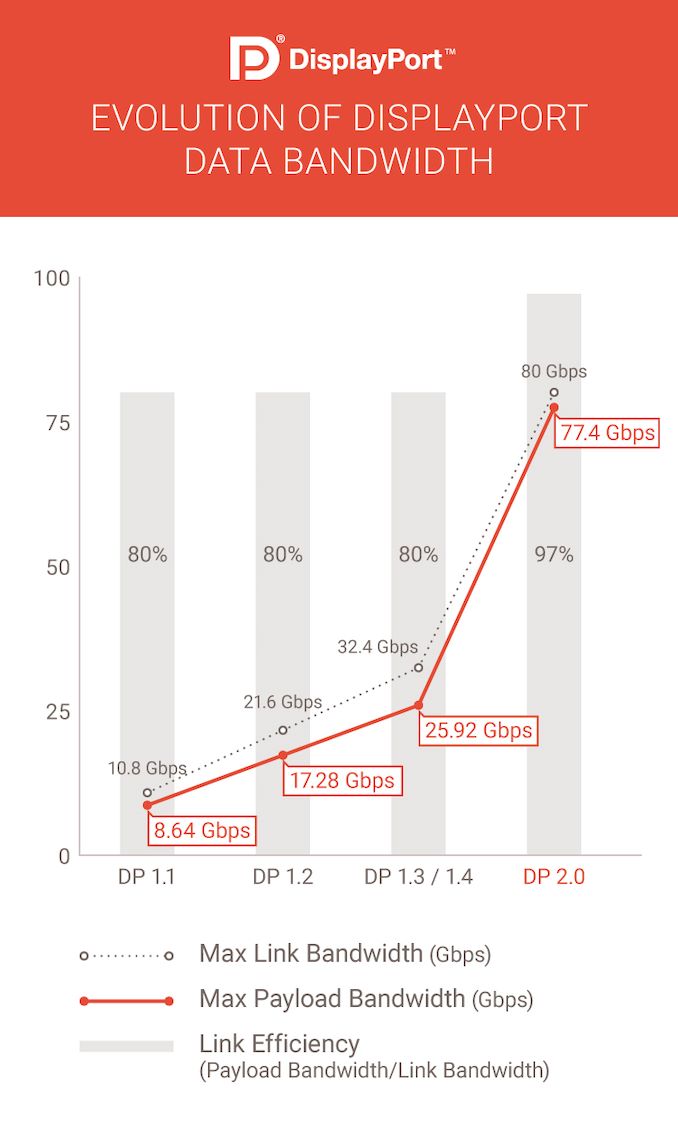
Putting all of this in practical terms for a moment, for the VESA and its member manufacturers then, the new standard opens the door to higher resolution, higher refresh rate, and wider color gamut monitors. DisplayPort 2.0 is fast enough to not just support an 8K monitor without any kind of compression (including chroma subsampling), but it’s enough to do so at 30-bit color, allowing for HDR support even at that high of a resolution. Similarly, 10K monitors at 24-bit color are now possible without compression, and 16K monitors with compression. Overall the applications are about as varied as manufacturers want to go, with options ranging from ensuring there’s sufficient bandwidth for next-gen VR to enabling new daisy chaining setups (daisy chained 5K monitors, anyone?), not to mention even more interesting setups such as mixing USB data with high resolution DisplayPort monitors. Many things which the VESA is happy to point out that even HDMI 2.1 can’t do, due to the former’s significant bandwidth advantage (all of this solidly putting DisplayPort back on top in terms of total bandwidth).
DisplayPort 2.0 Under the Hood: Thunderbolt 3, UHBR, & Passive Cables
Diving a bit deeper into today’s announcement, let’s talk about the DisplayPort 2.0 physical layer. For the last half decade or so, VESA members have commented here and there about where the standard might go in the future, and what direction the physical ports would take. Developing the next generation of high bandwidth external interfaces only gets harder and more expensive with each generation, which has increasingly caused the various standard bodies to coalesce around a handful of physical layers and data transmission technologies. At the same time, the physical DisplayPort, which was designed over a decade ago, wasn’t originally designed to scale up to the amount of bandwidth DisplayPort 2.0 will be pushing. As a result every option has been on the table to some degree, including disregarding most of the DisplayPort standard, DisplayPort and all.
The end result then is an interesting compromise, and importantly, one that delivers more bandwidth while retaining backwards compatibility with existing DisplayPort gear. The DisplayPort itself is staying: it and the USB-C connector (via DP alt mode) are both official ports for the new DisplayPort 2.0 standard. And because of this, the number of pins and resulting high speed data lanes is remaining unchanged as well, with DisplayPort continuing to operate over 4 lanes. Finally, the DisplayPort 2.0 standard also retains the technology’s packet-based approach to communications, which means that image data continues to be sent as packets over a fixed bandwidth link, as opposed to pixel-centric pixel clock approaches.
So what has changed to enable DisplayPort 2.0? While the titular DisplayPort itself has stayed, the rest of the physical layer has been almost entirely replaced… with Thunderbolt 3.
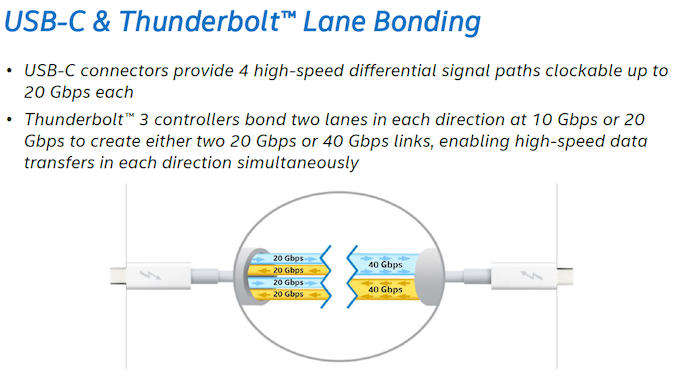
Rather than attempting to reinvent the wheel, for DisplayPort 2.0 the VESA decided to take advantage of Intel’s existing Thunderbolt 3 technology, which already hits the data rates that the VESA was looking for. While initially a proprietary Intel technology, Intel released the technology to the wider industry as a royalty-free standard earlier this year. This allowed third parties to not only create pure Thunderbolt 3 devices without paying Intel, but also allowed Thunderbolt 3 technology to be repurposed for other standards. So whereas USB4 is a more straightforward rebranding of Thunderbolt 3, for DisplayPort 2.0 takes it in a different direction by essentially creating a one-way Thunderbolt 3 connection.
Under the hood, Thunderbolt 3 operates fairly similarly to DisplayPort, with 4 high-speed each lanes carrying packets of information at 20 Gbps. However while TB3 is a true bi-directional, full-duplex link with 2 lanes allocated for each direction, DisplayPort is focused on sending large volumes of data in just one direction: out. As a result, DisplayPort 2.0 reverses the two inbound lanes to outbound lanes, allowing the four total lanes to be combined into a single 80 Gbps link.
| Thunderbolt 3 vs. DisplayPort 2.0 | ||||
| Thunderbolt 3 | DisplayPort 2.0 | |||
| Max Cable Bandwidth | 80Gbps | 80Gbps | ||
| Max Channel Bandwidth | 40Gbps (Full Duplex, Bidirectional) |
80Gbps (Simplex, Unidirectional) |
||
| Physical Layer | Thunderbolt 3 | Thunderbolt 3 | ||
| DisplayPort | 2x DP 1.4 Streams | 1x DP 2.0 Streams | ||
| Passive Cable Option | Yes (20Gbps) | Yes (40Gbps) | ||
| Interface Port | USB Type-C | DisplayPort USB Type-C |
||
Speaking of the link itself, the move to Thunderbolt 3 technology also means that DisplayPort inherits Thunderbolt 3’s signal encoding scheme. Whereas DisplayPort 1.x has always used relatively inefficient 8/10b encoding – resulting in 20% overhead – DisplayPort 2.0 will offer 128/132b encoding, which has just 3% overhead. This is why the practical bandwidth gains for DisplayPort 2.0 are more than just the raw bandwidth gains; the standard doesn’t just get more bandwidth, but it uses it more efficiently. Consequently, at its highest data rate, DisplayPort 2.0 will be able to offer 77.37 Gbps of bandwidth.
But what of cables? Here’s where things get a bit trickier, both for the VESA and for users. Thunderbolt 3 pushed the limits of copper cabling, and as a result for all but the shortest runs it requires active cabling, with transceivers at each end of a cable. While effective, this drove up the cost of Thunderbolt 3 cables versus relatively cheap all-copper commodity USB 3 and DisplayPort 1.x cables. By using Thunderbolt 3 as the basis of their new standard, the VESA has inherited the cable technology limits of the standard as well.
The answer to the cable question then is that the VESA hasn’t really answered it. Instead, they’re focusing on what they can do now with passive cables. All told, the DisplayPort 2.0 actually introduces not one, but three new data rates: 10 Gbps per lane, 13.5 Gbps per lane, and 20 Gbps per lane. Dubbed Ultra High Bit Rate (UHBR), the for free-standing monitors the VESA right now is focusing on 10 Gbps per lane (UHBR 10), which will deliver a total of 40 Gbps of bandwidth.
At just half the data rate of full-fat DisplayPort 2.0 (and Thunderbolt 3), UHBR 10 is resilient enough that it can operate over standard passive copper cabling, and cables should have little issue reaching 2-3 meters. The VESA has actually been preparing for this for some time now, and UHBR 10 aligns with their previously-launched DisplayPort 8K cable certification program; 8K-certified cables will be able to meet the signal integrity requirements for UHBR 10.
| DisplayPort 2.0: UHBR Modes | ||||||||||||
| Standard | Raw | Effective | Cable | |||||||||
| UHBR 10 | 40 Gbps | 38.69 Gbps | Passive Copper | |||||||||
| UHBR 13.5 | 54 Gbps | 52.22 Gbps | Tethered | |||||||||
| UHBR 20 | 80 Gbps | 77.37 Gbps | Tethered | |||||||||
Past that, however, the VESA isn’t currently exploring (or at least not focused on) passive cables for the higher bitrate modes. Instead, the group envisions UHBR 13.5 and UHBR 20 being tethered setups: manufacturers would ship devices with an appropriate port/cable already attached. These can potentially be passive cables for very short runs (think laptop docks), or integrated active cables for longer runs. I should note that the group hasn’t closed the door entirely to more traditional passive cable setups for these higher bitrates, but at least for the moment the group doesn’t see very many non-tethered use cases coming to market in the near future.
Tangentially, here, there is one more signal-related changed to the DisplayPort standard. Forward Error Correction (FEC), which was introduced to DisplayPort 1.4 as part of the Display Stream Compression (DSC) standard, is now a core part of DisplayPort 2.0. So on a 2.0 link, FEC will be in use at all times, reflecting the challenge in getting these high speed interfaces to constantly transmit data in an error-free manner.
DisplayPort 2.0 Features: Mandatory DSC, Branch Devices, & Panel Replay
Shifting gears, along with the significant physical layer changes being introduced in DisplayPort 2.0, the standard is also introducing some much more modest feature changes.
First and foremost, Display Stream Compression support is now mandatory for DisplayPort 2.0 devices. Previously introduced as part of DisplayPort 1.4 – and not really hammered out entirely until a couple of years after that – DSC is the group’s standard for “visually lossless” image compression. Operating on small groups of pixels, DSC offers modest compression ratios of around 3:1, with the goal of compressing images just enough to save power and bandwidth without introducing visual artifacts and without adding significant latency.

At any rate, starting with DisplayPort 2.0, DSC is now a core part of the DisplayPort standard. To be clear, 2.0 devices do not have to use DSC – the preference is clearly towards uncompressed images when the bandwidth allows for it – however 2.0 devices must be able to encode, pass, and decode DSC compressed data. This will, over time, lay the groundwork for manufacturers to develop and release monitors that require DSC (at least in certain modes), as they’ll be able to sell monitors knowing that all 2.0 devices can drive them.
Speaking of efficiency, the DisplayPort 2.0 standard is also introducing another feature focused on power efficiency, and that’s Panel Replay. Derived from earlier Panel Self Refresh technologies that are part of the embedded DisplayPort standard, Panel Replay is a partial self-update mechanism that allows a system to only transmit and update the portion of an image that has changed since the previous video frame. Like PSR in eDP, this feature is primarily intended for laptops and other mobile devices, where power consumption and the resulting impact to battery runtimes are important qualities. Transmitting less data reduces not only the amount of energy used chauffeuring bits around, but it also reduces the amount of processing required in a display controller.
Last but not least, DisplayPort 2.0 is also updating how “branch devices” work in the standard. Essentially the splitters in a Multi Stream Transport setup, DisplayPort 1.x required that the branch device be capable of decoding a DisplayPort bitstream, which is not an easy feat with 20 Gbps+ of data. So instead, for 2.0, branch devices are being simplified some, and now will just be able to forward data rather than having to decode it. This should make MST (and daisy chaining) a bit easier to implement overall, as branch devices won’t need to be as complex.
On a final note, ahead of today’s specification release I also asked about the state of variable refresh support on DisplayPort. VESA Adaptive Sync is an optional feature for monitors under DisplayPort 1.x, and it will remain so under DisplayPort 2.0. So manufacturers can continue adding it as a useful feature for their monitors, but there are no plans to make it mandatory.
Coming In Late 2020
Wrapping things up, the latest version of the DisplayPort standard is easily the biggest update to the PC display standard since it launched in 2007. By replacing the DisplayPort physical layer with Thunderbolt 3, the VESA has greatly increased DisplayPort’s bandwidth potential, laying the groundwork for 8K monitors and beyond. This update doesn’t come for free, and the VESA’s member companies will have to tackle the same kind of high-bandwidth cabling issues that Thunderbolt 3 itself had to address over the last few years, but ultimately it’s a situation that gives the display standard a major shot in the arm in terms of bandwidth, while pushing the PC industry ever so closer towards using a handful of common standards for all high bandwidth I/O.
As for the first retail products, the good news is that this will show up sooner than later. Because the new standard is based on the Thunderbolt 3 physical layer, member companies can hit the ground running on development and testing. As a result, the VESA expects the first retail devices to show up in the latter part of 2020, less than 18 months from now.
from AnandTech https://ift.tt/2Fyw7Tg
Bombardier sells money-losing regional jet business to Mitsubishi
Bombardier Inc said it will sell its money-losing regional jet business to Japan's Mitsubishi Heavy Industries Ltd (MHI) for $550 million in cash, in a deal marking the Canadian plane and train maker's exit from commercial aviation. Read More
from Canoe https://ift.tt/2FzOtD6
from Canoe https://ift.tt/2FzOtD6
2.5 tonnes of meth seized in the Netherlands — the largest haul of the drug in Europe
AMSTERDAM -- Dutch police said on Wednesday they had seized 2.5 tonnes of methamphetamine, in what they said was the largest haul of the drug to date in Europe, with a street value estimated in the "hundreds of millions of euros." Read More
from Canoe https://ift.tt/2ZU0T0x
from Canoe https://ift.tt/2ZU0T0x
Canadians detained in China, meat dispute hot topics for Trudeau at G20 summit
OTTAWA -- Prime Minister Justin Trudeau is leaving for a major international summit in Japan this morning, hoping to make progress, or at least find allies, in a multi-front dispute with China. Read More
from Canoe https://ift.tt/2INCFPS
from Canoe https://ift.tt/2INCFPS
SK Hynix Starts Production of 128-Layer 4D NAND, 176-Layer Being Developed
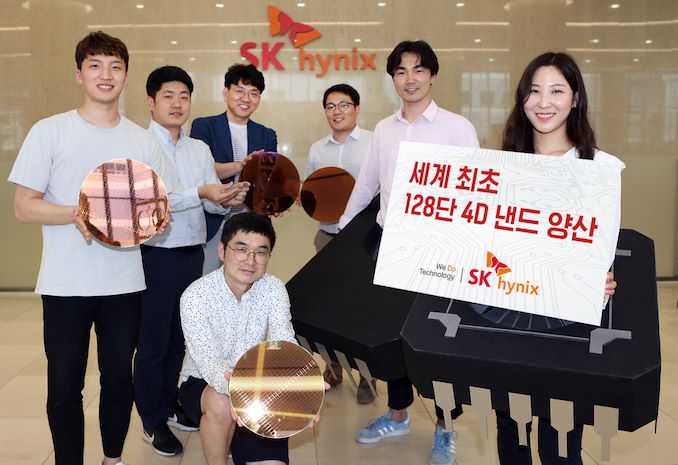
SK Hynix has announced it has finished development of its 128-layer 1 terabit 3D TLC NAND flash. The new memory features the company’s charge trap flash (CTF) design, along with the peripheral under cells (PUC) architecture that the company calls ‘4D’ NAND, announced some time ago. The new 128-layer TLC NAND flash devices will ship to interested parties in the second half of this year, and SK Hynix intends to offer products based on the new chips in 2020.
1 Tb 128-Layer ‘4D’ TLC NAND
SK Hynix’s 1 Tb 128-layer TLC NAND chip features four planes as well as a 1400 MT/s interface at 1.2 Volts. The quad-plane architecture along with a 1400 MT/s I/O bus will make the new TLC NAND devices not only significantly denser (in terms of Gb per mm2) than previous-generation products, but also at least 16% faster. In fact, real-world performance increase could be even higher as SK Hynix once said that its CTF design would enable a faster program time (tPROG) as well as a faster read time (tR).

To stack 128 layers inside its 6th Generation 3D NAND chips, the company had to use a multi-stacked design along with numerous new technologies, including ultra-homogeneous vertical etching technology as well as high-reliability multi-layer thin-film cell formation technology. Meanwhile, to increase performance of the I/O bus without increasing power consumption of the device, SK Hynix implemented its ultra-fast low-power circuit design.
It is noteworthy that transition to CTF + PUC architecture, along with various optimizations, enabled SK Hynix to reduce the number of process steps by 5% as well as increase bit productivity per wafer by 40% when compared to 96-layer TLC NAND. As a result, we should expect to see the new NAND run through the entire product lineup in due course.
Various Applications
SK Hynix and its partners will use the company’s 1 Tb 128-layer TLC NAND chip for a variety of applications.
“SK Hynix has secured the fundamental competitiveness of its NAND business with this 128-Layer 4D NAND,” said Executive Vice President Jong Hoon Oh, head of global sales & marketing. “With this product, with the industry’s best stacking and density, we will provide customers with a variety of solutions at the right time.”
Initial 1 Tb 128-layer TLC NAND chips that SK Hynix will start shipping in the second half of the year will be used primarily for mobile storage devices, such as USB drives and memory cards.

In the first half of next year SK Hynix promises to roll out its UFS 3.1 storage products based on the new 1 Tb devices. The company plans to offer 1 TB UFS 3.1 chips that will consume up to 20% less when compared to similar products that use 512 Gb ICs.
Later in 2020, SK Hynix intends to offer 2 TB client SSDs based on its own controller, as well as 16 and 32 TB server SSDs for datacenters ,.
176-Layer 4D NAND Incoming
String stacking technology, as well as the multi-stacked design, will enable SK Hynix to keep increasing the number of layers. SK Hynix says that it is currently developing 176-layer 4D NAND flash, but does not disclose when it is expected to become available.
Related Reading
- Flash Memory Summit 2018, SK Hynix Keynote Live Blog: NAND Development
- SK Hynix Begins Sampling of 96-Layer 1 Tb 3D QLC NAND
- SK Hynix Launches 96-Layer 3D NAND and Discloses QLC Plans
- SK Hynix Announces SSDs with 72-Layer 3D NAND ICs, Own Controllers
- SK Hynix Launches 2nd Gen Enterprise SSD: 72-Layer 3D NAND & In-House Controller
Source: SK Hynix

from AnandTech https://ift.tt/2FAVOSS
Vulnerability in AMD’s Secure Encrypted Virtualization for EPYC: Update Now to Build 22

One of the key elements of building a processor is that designing a secure product involves reducing the ‘attack surface’ as much as possible: the fewer ways an attack can get in, the safer your product is. For the white knights of the security world, when a vulnerability is found, the process usually goes through a period of reasonable disclosure, i.e. the issue is presented to the company, and they are often given a certain time to fix the issue (to help customers) before the full disclosure is made public (in case it might be swept under the rug). Using this method, a researcher at Google found a vulnerability in the way AMD’s EPYC processors provide Secure Encrypted Virtualization (SEV) which would allow an attacker to recover a secure key that would provide access between previously isolated VMs on a system. AMD has since released an update to the firmware which patches this issue.

from AnandTech https://ift.tt/2FwRWCk
Nicaragua arrests four men suspected of ties to Islamic State
MANAGUA — Four men with suspected ties to the Islamic State militant group were captured on Tuesday by members of the Nicaraguan armed forces after entering the country illegally from Costa Rica, Nicaraguan police said. Read More
from Canoe https://ift.tt/2FxWfgV
from Canoe https://ift.tt/2FxWfgV
Michael Jackson fans sing, sob, leave sunflowers and roses on 10th anniversary of death
LOS ANGELES — With roses crafted into heart shapes and crowns made of bright yellow sunflowers, Michael Jackson fans from as far afield as Iran and Japan paid tribute on Tuesday to the King of Pop on the 10th anniversary of his death. Read More
from Canoe https://ift.tt/2KEYwec
from Canoe https://ift.tt/2KEYwec
U.S. Special Counsel Robert Mueller to testify before House panels on July 17
WASHINGTON -- U.S. Special Counsel Robert Mueller, who issued a report in April on Russian meddling in the 2016 presidential election, will testify in open session before the House of Representatives Judiciary and Intelligence Committees on July 17, the panels' Democratic chairmen said on Tuesday. Read More
from Canoe https://ift.tt/2Yfh9sk
from Canoe https://ift.tt/2Yfh9sk
Kate Mara needed emergency caesarean and blood transfusion for baby’s birth
New mother Kate Mara had to abandon her birth plan after developing a potentially harmful disease and a high fever which required her to undergo an emergency caesarean section. Read More
from Canoe https://ift.tt/31Tj8oq
from Canoe https://ift.tt/31Tj8oq
‘The Office’ to leave Netflix in 2021
LOS ANGELES -- Comcast Corp's NBCUniversal will pull popular workplace comedy "The Office" from Netflix Inc in the United States in 2021 and make the show available on its own streaming service, the company said on Tuesday. Read More
from Canoe https://ift.tt/2Nd9Sbs
from Canoe https://ift.tt/2Nd9Sbs
Tuesday, 25 June 2019
Only 4 in 10 countries criminalize marital rape: UN study
UNITED NATIONS, June 25 (Thomson Reuters Foundation) - The home is one of the most dangerous places for women, the United Nations said on Tuesday, as research showed only four in 10 countries criminalize marital rape. Read More
from Canoe http://bit.ly/2Y8TkCy
from Canoe http://bit.ly/2Y8TkCy
‘SHE’S NOT MY TYPE’: Trump denies sexual assault accusation
WASHINGTON -- U.S. President Donald Trump denied a new accusation of sexual violence raised by a woman who said she had to fight him off more than 20 years ago in the dressing room of a high-end New York department store. Read More
from Canoe http://bit.ly/2X1H8lV
from Canoe http://bit.ly/2X1H8lV
Facebook adds Canada to list of countries with rules for political ads
SAN FRANCISCO -- Facebook Inc on Tuesday added Canada and Ukraine to the list of countries where advertisers looking to run political ads on its platform must first verify their identity and disclose who paid for the ads. Read More
from Canoe http://bit.ly/2xblykb
from Canoe http://bit.ly/2xblykb
Corsair’s PCIe 4.0 NVMe SSD Found For Pre-Order: MP600 up to 2TB

Amazon Japan has started to take pre-orders on Cosair’s upcoming PCIe 4.0 NVMe SSD. The MP600 SSDs will ship in mid-July, several days after AMD and its partners start to sell platforms that support the PCIe 4.0 interface.
At press time, Amazon Japan is offering Corsair MP600 M.2-2280 SSDs with a PCIe 4.0 x4 interface featuring 1 TB and 2 TB capacity for ¥36,936 ($320) and ¥66,852 ($579), respectively. Considering the fact that we are talking about ultra-high-end client SSDs aimed at expensive desktops, their prices are not exactly surprising. Meanwhile, keep in mind that these are not their official MSRPs.
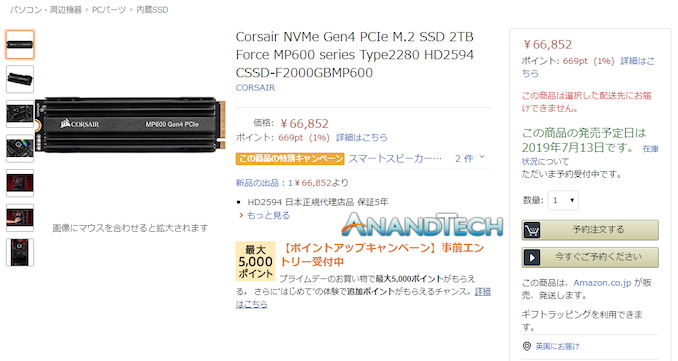
According to Corsair, its MP600 SSDs will offer up to 4950 MB/s sequential write speed as well as up to 4250 MB/s sequential read speed when used with a PCIe 4.0 x4 interface, which is substantially faster when compared to modern PCIe 3.0 x4 drives.
Corsair’s MP600 drives are based on Phison’s PS5016-E16 controller as well as 3D TLC NAND memory. Considering that Phison usually sells controllers and NAND flash memory as a turnkey solution, expect other suppliers of SSDs to offer drives very similar to the MP600 family by Corsair at around the same timeframe. In the meantime, Corsair definitely deserves a credit for starting to offer its PCIe 4.0 SSDs ahead of competitors.
We saw a number of PCIe 4.0 drives at Computex this year, so we expect the market to have a sizeable number available in due course:
- Phison’s PS5016-E16 & PS5019-E19: The First PCIe 4.0 Client SSD Controllers
- Corsair Announces MP600 NVMe SSD With PCIe 4.0
- More 2TB PCIe 4.0 SSD Options: Patriot with Custom Firmware coming Q4
- TeamGroup Cardea Zero PCIe 4.0 x4 SSD: Up to 1 TB
- Galax Goes White: A PCIe 4.0 2TB SSD with a White PCB
- Essencore 2 TB PCIe 4.0 SSD Enters The Game
- GIGABYTE’s PCIe 4.0 SSD Uses 77g of Copper Due to 8W TDP, up to 2TB

from AnandTech http://bit.ly/2NckTKi
Nadal: Wimbledon’s seedings system ‘not a good thing’
LONDON -- Spaniard Rafael Nadal has criticized Wimbledon's unique seedings formula, which could hinder his chances of a third title when the tournament starts on Monday. Read More
from Canoe http://bit.ly/2FwLonr
from Canoe http://bit.ly/2FwLonr
Daredevil Nik Wallenda says he’ll cross active volcano
High-wire daredevil Nik Wallenda is planning to walk across an active volcano after completing a stunt high above New York City on Sunday night. Read More
from Canoe http://bit.ly/2X4vrea
from Canoe http://bit.ly/2X4vrea
John Stamos returning to ‘You’ Season 2
John Stamos will be reprising his role as Dr. Nicky in the second season of hit TV series You. Read More
from Canoe http://bit.ly/2J5xqdg
from Canoe http://bit.ly/2J5xqdg
Avril Lavigne announces first tour in 5 years after Lyme disease battle
Avril Lavigne is preparing to take to the stage for the first time in five years after announcing dates for a North American tour on Monday. Read More
from Canoe http://bit.ly/2NcbUsy
from Canoe http://bit.ly/2NcbUsy
Elton John’s new song added to new ‘Lion King’ soundtrack
Elton John has written a new song for the soundtrack of Disney’s The Lion King revamp. Read More
from Canoe http://bit.ly/2ZMapCB
from Canoe http://bit.ly/2ZMapCB
‘I WAS SCAMMED’: Pamela Anderson calls boyfriend Adil Rami a cheating ‘monster’
Pamela Anderson has split from her boyfriend of two years, Adil Rami, and as is clear from her latest post, the breakup was nothing but heartbreaking and ugly. Read More
from Canoe http://bit.ly/2XyXkPQ
from Canoe http://bit.ly/2XyXkPQ
Video of Jussie Smollett with noose around his neck released
A police bodycam video, showing actor Jussie Smollett with a noose around his neck on the night he was allegedly attacked, has been released. Read More
from Canoe http://bit.ly/2Ydc3ga
from Canoe http://bit.ly/2Ydc3ga
NATO urges Russia to destroy new missile, warns of response
BRUSSELS -- NATO urged Russia on Tuesday to destroy a new missile before an August deadline and save a treaty that keeps land-based nuclear warheads out of Europe or face a more determined alliance response in the region. Read More
from Canoe http://bit.ly/2RzxzcB
from Canoe http://bit.ly/2RzxzcB
Malaysia shuts nearly 500 schools over toxic fumes; dozens hospitalized
KUALA LUMPUR -- Malaysia has ordered nearly 500 schools and kindergartens to close until Thursday, after dozens of people were hospitalized with symptoms suggesting they breathed toxic fumes, possibly from industrial waste, the second such incident this year. Read More
from Canoe http://bit.ly/2NaYeOs
from Canoe http://bit.ly/2NaYeOs
Noctua Shows Off Updated 'D Series' 140mm CPU Coolers: NH-D15 Gets A Successor
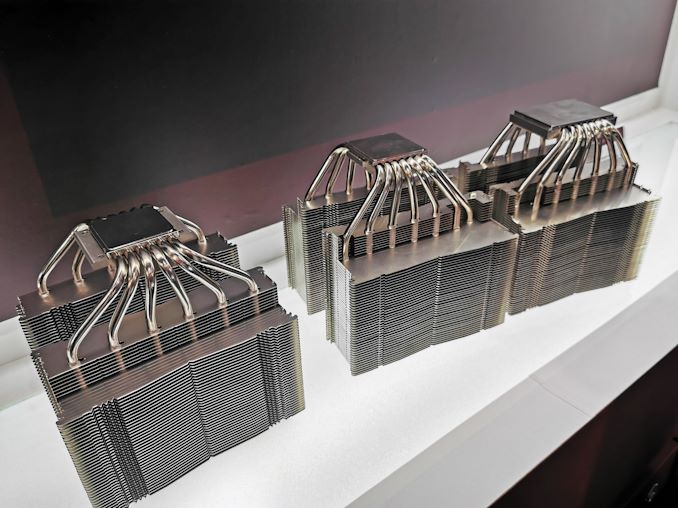
During Computex 2019, Noctua announced its plans to update its fabled D series of CPU coolers with a new design. The new, currently-unnamed coolers incorporate an extra heat pipe as compared to the current NH-D15 and NH-D15S, as well as increase performance and utilize an asymmetrical design for improved PCIe slot clearance.
Noctua of course is well known in the air cooling market for its high quality fans and coolers, which are aimed at the premium end of the market and deliver some of the best performance on the on the market today. Not hurting the company's visibility either is their highly distinctive beige and brown color scheme, which make their products easy to tell apart from more commodity products.
At Computex in addition to its fanless concept CPU cooler design, Noctua also had its next generation of D series CPU cooler on display. The new cooler features seven heat pipes – up from the traditional six of the previous NH-D15 models – and the heatsink itself has been tweaked to offer 10% more surface area for heat dissipation than previous models. One of the most interesting aspects is that Noctua revealed that the new D series coolers are designed to dissipate up to 400 W of heat, which makes them highly suitable for beefier sockets such as AMD's TR4 and SP3.
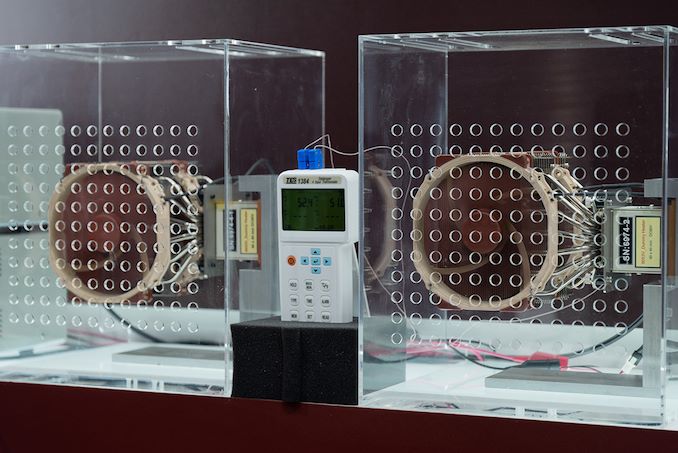
Showing off one of the prototypes in action, the company had one of the new coolers setup against one of its current NH-D15 models in a custom designed test chamber, using the two otherwise-identical test systems to show the differences in performance between the two models. And since this was designed to be a test of the heatsink and not the fans, only the heatsink itself was swapped here; both systems used the same NF-A15 PWM cooling fans.

The new D series cooler is on the left, the pre-existing NH-D15 is on the right
Overall we didn't see a massive difference – and to be fair, it was very hot (ed: Taipei in June), so ambient temperatures were running high – but none the less, the prototype cooler did come out consistently ahead of the NH-D15. In its custom chamber, the new D series cooler had one degree advantage over its predecessor.

Shifting gears to retail matters, Noctua is planning on releasing two versions of the new D series coolers, rolling out both a single fan model and a dual fan model. The new coolers will include a traditional multi-socket mounting kit, which will support AM4, LGA20xx, and LGA115x. Meanwhile there will be separate dedicated TR4 models due to the larger base plate needed to properly match the large IHS used on AMD's Threadripper processors. Each cooler will also be bundled with a tube of its new NT-H2 thermal compound.
At this point the company hasn't announced an official release date, but it's likely that the next generation of D-type coolers will be available by the end of the year, with a pricing structure similar to that of the current NH-D15 and NH-D15S models.
| Want to keep up to date with all of our Computex 2019 Coverage? | ||||||
 Laptops |
 Hardware |
 Chips |
||||
| Follow AnandTech's breaking news here! | ||||||

from AnandTech http://bit.ly/2Y8ijGg