Pages

Thursday, 30 June 2022

How Arch Hades Became The Highest-Paid Poet Of All Time

More mysterious than her verses is the life of the 29-year-old Russian poet Arch Hades who is based in Britain and gained fame on Instagram. She is the world's best-paid poet of all time. But her real name is not Arch Hades, and she refuses to reveal her real identity, which she has reportedly changed multiple times due to a complicated personal history. After the NFT was bought for $525,000 which was sold at an auction in New York, the gorgeous Arch Hades won over a million followers with her heartbreaking poems influenced by her divorce.

Arch Hades is among the modern and contemporary literary trend called Insta-poets. With self-published poetry snippets on social media by poets like Hades, Rupi Kaur, and Lang Leav which accelerated them to popularity. And these aren't poor artists either; the Instagram poets who top best-seller lists have book agreements thanks to their growing fan bases. However, Hades dislikes being called Insta-poet.

RELATED: Here's How Kenneth Copeland Became One Of The Richest Authors Of All Time

3 Arch Hades' Complicated Youth In London

Hades was born in Russia, which she claimed to be run entirely by the mob. Initially, her family had nothing and confessed that the powerful elite gave themselves whatever they wanted. Everybody else was powerless, as she conveyed. Hades' father started to gain a reputation and aspired to reform, but a horrible event occurred—his father was killed. Hades was eight years old when her bereaved family fled to stunning and wealthy city of London. They were forced to change their identities and go through various complex procedures as a result. The young Hades' most significant issue in Britain was that she couldn't speak the language. Despite being referred to by her classmates as 'the Russian,' she started school and learned the language. In her teens, she made a few close friends and discovered her love of poetry, especially the classics, while seeking refuge in the school library.

Hades received inspiration from Lord Byron, who is recognized as one of the finest English poets and continues to influence her work, particularly when she was younger. She even named her corgi, Byron, after the poet. Her five-year-old corgi gained 8,000 Instagram followers. She consumes literature in her free time and has an eclectic reading list that includes the rich works by Goethe, Virginia Woolf, Somerset Maugham, and cult Slovenian philosopher Zizek. Her accent is a defining feature of her overall expensive mystery, which is a blend of influences from boarding schools in Russia, America, and England, where she had gone exploring.

2 Living A Glamorous Life As A Divorcee

Writing openly about her grief and loss, including the dissolution of her marriage owing to a problematic long-distance relationship, was a healing experience for the brilliant writer, who first began posting her iconic and beautiful poems on her Instagram account in July 2018. She views it as the most remarkable step she has ever taken because it launched her to fame on Instagram and helped millions of people understand modern anxiety and loneliness. She is well known for Romantic lyricism and for examining the poetry of philosophy in a traditional, rhyming manner. She wrote four-volume poetry: High Tide in 2018, Fool's Gold in 2020, Paper Romance in 2021, and Arcadia in 2022. Arch's first book, High Tide, which has since become an official best-seller with sales of over 10,000, peaked at number seven on Amazon's UK Poetry list and entered the Top 20 in the USA Poetry charts in 2019. It became the number one poetry best-seller in Canada and Australia in 2019 as numerous fans patronize her artwork.

Arch Hades frequently contributes commentary on cultural discourse to influential newspapers, reads poetry, and gives philosophy lectures as she is demanded by companies. In 2021, she spoke at the prestigious Oxford University about 21C existentialism; in 2022, she discussed the connection between art and philosophy on a panel at the annual UCL conference. Also, the author claims to be influenced by the Russian poets of the 19th century and prefers a classic approach to verse over more modern techniques, unlike more poets of this time.

1 Achieving Fame And Building Her Wealth

After being discovered and known for her works, the exciting partnership between Andrés Reisinger and Arch Hades began. Her masterwork Arcadia was illustrated and offered for sale at Christie's New York in 2021 as a piece of fine art, setting records and going for $525,000. The Florence Palazzo Strozzi hosted the museum debut of Arcadia in May 2022. The poem The Story of Arcadia which has 648 lines and is rhyming, discusses how the 20th-century organized religions' attempt to fill the hole of habit and purpose created by mass media has contributed to our existential crises of alienation and anxiety in the 21st century.

Hades additionally collaborated on the fine art NFT with Grammy-winning artist RAC. NFTs are digital assets that track ownership, and their use has skyrocketed recently. They operate on blockchain networks, comparable to cryptocurrencies like Bitcoin and Ethereum. These are the most profitable channel for Hades' artworks. Many details of Arch Hades' life and career are still full of mystery, but she has persisted in dominating the poetry and art worlds. She serves as an example for others, demonstrating that expressing oneself is never wrong and that this could be the most colossal plot twist of one's life.

READ NEXT: 10 Of History's Great Poets Who Suffered From Depression

Sources: Arch Hades, Female First, Daily Mail UK


from TheRichest - Feed https://ift.tt/t3insg6

The Net Worth Of The Cast Of 'Good Luck To You Leo Grande', Ranked

Who could have predicted that a British comedy-drama about a widow's sexual awakening would have garnered success? The film premiered at the beginning of this year at the Sundance Film Festival before it was released this month (via Lionsgate at traditional theaters in the UK and via Searchlight Pictures streamed on Hulu in the US).

Emma Thompson and Daryl McCormack take everything that society thinks they know about relationships, intimacy, and the sex industry and turns it upside down! This is a film that is short in cast members but still packs a big punch. The chemistry between the unlikely pair who are each leading somewhat secret lives is all we need!

RELATED: The Net Worth Of The Cast Of 'The Boys', Ranked

Although Emma Thompson, 63, plays a widow who is testing the waters after a passionless marriage, in real life she has been happily married to hubby Greg Wise since 2003. In this film, she portrays the character of Nancy Stokes a.k.a Susan Robinson but you might know Thompson from her work in the Harry Potter franchise and Nanny McPhee. And in addition to being a successful actress, Thompson is also a Dame! Her full name is Dame Emma Thompson DBE and as of this writing, her net worth is a whopping $60 million.

McCormack, 29, is best known for his work in Peaky Blinders. The Irish actor, who plays Leo Grande a.k.a Connor in this film is a true rising star with interesting roots. His mother's side of the family has deep roots in Ireland and while on a vacation in California one year, she met his father who hailed from Baltimore. Though the actor's mother moved back to Ireland to raise her son, he maintains strong contact with his father's side of the family to this day. Today, his net worth is estimated at $2 million but as he is just an up-and-coming actor, that number is likely to change in big ways soon.

Isabella "Izzy" Laughland, 31,  plays the part of Becky. Becky is a former student of Emma Thompson's character who runs into the two main characters near the end of the film. She has a short part but it's impactful because Becky's role in the movie helps Thompson's character to realize some old mistakes and past judgements and ultimately, helps with her personal growth journey. The British-born actress' net worth is said to be estimated at $2 million.

Charlotte Ware plays the role of "Waitress 1" in the film, serving the slightly odd yet dynamic pair. The new actress, who is also a talented musician, counts this as her first official film credit. As such, she has yet to amass the wealth that a typical actor has and doesn't have a net worth listed just yet. We all have to start somewhere!

Carina Lopes is credited as "Waitress 2" in the movie. Since the film heavily revolves around the two main characters, in situations like these, it can be difficult to gain traction and exposure for a new actress with a smaller part in a movie but since Good Luck To You Leo Grande is being called a "one-of-a-kind" film, we have a good feeling that Ms. Lopes' future will soon be full of acting gigs, exposure, and of course, a sizable net worth.

READ NEXT: Here's How Dakota Johnson Became A Hollywood Star

Source: wealthypersons.com, biowikis.com, networthpost.org, soundhealthandlastingwealth.com,


from TheRichest - Feed https://ift.tt/imZujXE

The AMD Ryzen 7 5800X3D Review: 96 MB of L3 3D V-Cache Designed For Gamers

The level of competition in the desktop CPU market has rarely been as intensive as it has been over the last couple of years. When AMD brought its Ryzen processors to market, it forced Intel to reply, and both have consistently battled in multiple areas, including core count, IPC performance, frequency, and ultimate performance. The constant race to improve products, stay ahead of the competition, and meet customers' changing needs has also sent the two companies off of the beaten paths at times, developing even wilder technologies in search of that competitive edge.

In the case of AMD, one such development effort has culminated with 3D V-Cache packaging technology, which stacks a layer of L3 cache on top of the existing CCD's L3 cache. Owing to the fact that while additional cache is beneficial to performance, large quantities of SRAM are, well, large, AMD has been working on how to place more L3 cache on a CPU chiplet without blowing out the die size altogether. The end result of that has been the stacked V-Cache technology, which allows the additional cache to be separately fabbed and then carefully placed on top of a chip to be used as part of a processor.

For the consumer market, AMD's first V-Cache equipped product is the Ryzen 7 5800X3D. Pitched as the fastest gaming processor on the market today, AMD's unique chip offers eight cores/sixteen threads of processing power, and a whopping 96 MB of L3 cache onboard. Essentially building on top of the already established Ryzen 7 5800X processor, the aim from AMD is that the additional L3 cache on the 5800X3D will take gaming performance to the next level – all for around $100 more than the 5800X.

With AMD's new gaming chip in hand, we've put the Ryzen 7 5800X3D through CPU suite and gaming tests to see if it is as good as AMD claims it is.


from AnandTech https://ift.tt/o9GQ5Pv

Samsung Starts 3nm Production: The Gate-All-Around (GAAFET) Era Begins

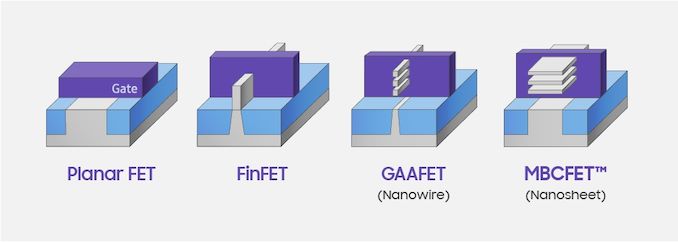
Capping off a multi-year development process, Samsung’s foundry group sends word this morning that the company has officially kicked off production on its initial 3nm chip production line. Samsung’s 3nm process is the industry’s first commercial production process node using gate-all-around transistor (GAAFET) technology, marking a major milestone for the field of silicon lithography, and potentially giving Samsung a major boost in its efforts to compete with TSMC.

The relatively spartan announcement from Samsung, which comes on the final day of Q2, announces that Samsung has begun production of chips on a GAAFET-enabled 3nm production line. The company is not disclosing the specific version of the node used here, but based on previous Samsung roadmaps, this is undoubtedly Samsung’s initial 3GAE process – essentially, Samsung’s earliest process node within a family. According to Samsung, the line will initially be used to produce chips for “high performance, low power computing”, with mobile processors to come later. Samsung’s early process nodes are traditionally reserved for the company’s internal use, so while Samsung isn’t announcing any specific 3nm chips today, it’s only a matter of time until we see a 3nm SoC announces from Samsung LSI.

Samsung has, for the most part, been quiet about its progress on 3nm/GAAFET this year. The last significant news we heard from the company on the matter was several months ago at the company’s Foundry Forum event, where the company reiterated plans to get 3GAE into production by the end of 2022. Given the previous silence and the cutting-edge nature of the technology, there had been more than some concern that 3GAE would be delayed past 2022 – adding on to delays that pushed the tech out of its original 2021 launch window – but with today’s announcement Samsung seems to want to put that to rest.

With that said, the devil is in the detail in these announcements, especially as to what’s said versus not said. Taken literally, today’s announcement from Samsung notably does not include any mention of “high volume” manufacturing, which is the traditional milestone for when a process node is ready for commercial use. So by merely saying 3nm is in production, Samsung’s announcement leaves the company with a fair bit of wiggle room with regards to just how many chips they’re capable of producing – and at what yields. The company was producing test chips back in 2021, so the matter is more nuanced than just firing up the fab, so the line between PR and productization is fuzzy, to say the least.

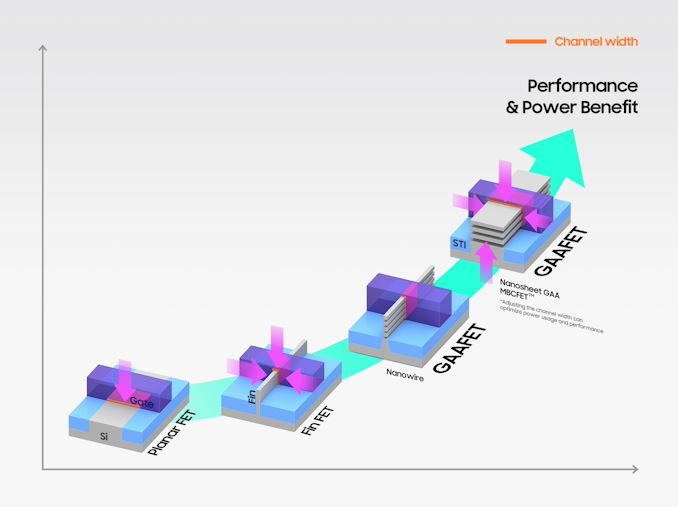
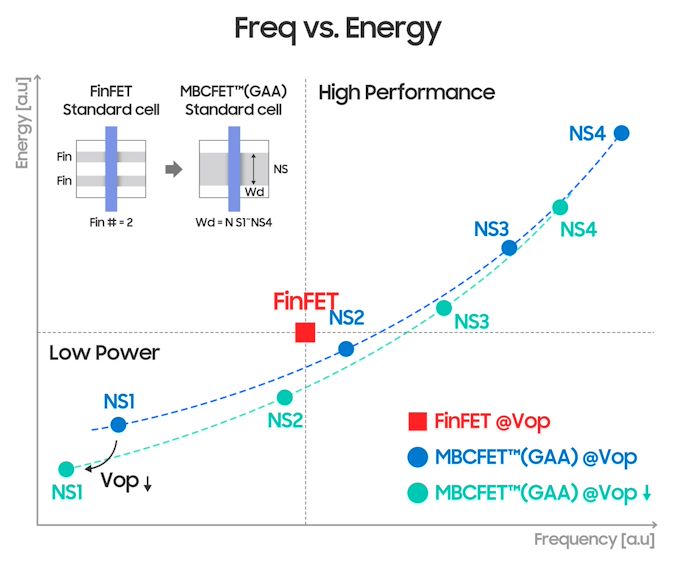
Still, today’s announcement is a major moment for Samsung, who has been working on 3nm/GAAFET technology since before 2019, when they initially announced the technology. Samsung’s specific flavor of GAA transistor technology is Multi Bridge Channel FET (MBCFET), which is a nanosheet-based implementation. Nanosheet-based FETs are extremely customizable, and the width of the nanosheet is a key metric in defining the power and performance characteristics: the higher the width, the higher the performance (at higher power). As a result, transistor designs that focus on low power can use smaller nanosheets, while logic that requires higher performance can go for the wider sheets.

Along with today’s production announcement, Samsung has also offered some updated size and performance figures comparing 3GAE to older nodes. Officially, 3GAE can offer 45% reduced power consumption or 23% improved performance compared to Samsung’s 5nm process (the company doesn’t state which flavor), with an overall reduction in feature size of 16%. These figures are notably different from Samsung’s previous (2019) figures, which compared the tech to Samsung’s 7LPP node. Given the change in baselines, it’s not clear at this point whether 3GAE is living up to Samsung’s initial claims, or if they’ve had to back off a bit for the initial version of their 3nm technology.

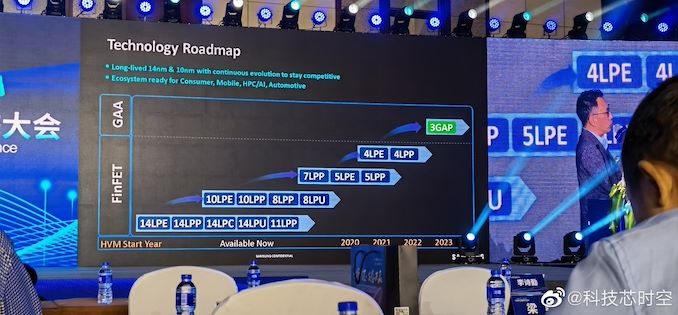
What is clear, however, is that Samsung has more significant improvements in mind for the second iteration of 3nm, which we know is 3GAP(lus). According to today’s press release, Samsung is expecting a 50% power reduction or 30% performance improvement versus the same 5nm baseline, with a much greater 35% area reduction. Today’s announcement doesn’t offer a date for 3GAP, but per previous roadmaps, 3GAP is expected to land around a year after 3GAE. 3GAP is also when we expect to see Samsung open the door to outside customers, though given the harsh competitive environment, nothing should be taken for granted.


Samsung Process Roadmap (July 2021)

The launch of Samsung’s 3nm process tech comes as the company is working to regain its footing against arch rival TSMC, who has clearly pulled into the lead in the 5nm/4nm generation. The gap between TSMC and Samsung has been wide enough that major customers such as Qualcomm have been porting high-performance chips like the Snapdragon 8 series from Samsung to TSMC, and at this point Samsung has seen few major 5nm/4nm wins compared to TSMC. If everything goes well, being the first fab with GAAFET tech could give Samsung a temporary-but-material advantage over TSMC, whose 3nm process is still using older FinFET-style transistors. But in order to pull that off, Samsung will need to reverse their earlier technical problems and deliver a performant, high-yielding process that’s far enough ahead to woo skeptical customers.


from AnandTech https://ift.tt/vGmSVlc

ASRock Releases Raptor Lake BIOS Updates For Its 600 Series Motherboards

While Intel has yet to officially announce its next (13th) generation of Core processors, this isn't stopping motherboard manufacturers from releasing products for them. Always eager to slide ahead of the competition and spur on new sales towards the later half of a platform's lifecycle, mobo makers are already releasing BIOSes that support Intel's future chips – parts which, officially speaking, don't even exist (yet).

Leading this charge is ASRock, who today has released a wave of new BIOSes for its 600 series motherboards designed to support Intel's next generation of processors. Looking to the future, the wave of BIOS updates is the vast majority of its first-generation LGA1700 motherboards, including their Z690, H670, B660, and H610 models.

At present, Intel has not officially announced its Raptor Lake processors yet, which are set to be Intel's next-generation of processors for desktops. This is an interesting move from ASRock, which means users currently with an ASRock 600-series motherboard can update the firmware now and not have to worry about installing the 'next-gen' later on.

ASRock's EZ Update utility, alongside its models with BIOS Flashback, can install the update with a USB stick with the core file on it. However, it remains to be seen if pre-existing 600-series boards will be updated at the retail/distribution level before the launch of Raptor Lake.


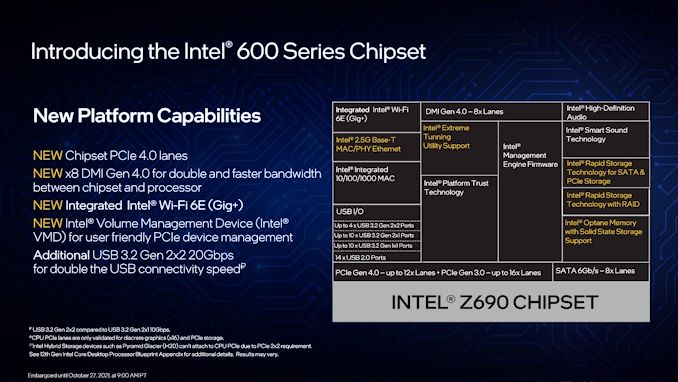
The current Intel Z690 chipset features and specifications

The biggest question, though, is why right now? Intel hasn't gone as far as announcing its 13th Gen Core series yet, although it is expected to be sometime by the end of this year. Officially, Intel has kept things about the upcoming Raptor Lake processors under wraps, and there is still very little to go on outside of unconfirmed sources and 'leaks.'

It's also worth noting that Intel is likely to announce a new motherboard chipset for its 13th Gen Core series processors, likely named Z790 following previous launches, which will also be on the LGA 1700 socket. This is much like with the release of the Z590 chipset, which also featured support for 11th and 10th Generation Core series processors.

Outside of ASRock's announcement, other motherboard vendors have been tight-lipped about the upcoming 13th Generation Core series processors and Intel. It remains to be seen if other vendors now choose to follow suit with ASRock in releasing firmware for unannounced processors, especially seeing as there are usually teething problems with launch day firmware, let alone firmware released months in advance.

Source: ASRock


from AnandTech https://ift.tt/wMOKN0m

A Peek Inside Lionel Messi's Ultra-Luxurious Car Collection

Argentine footballer Lionel Messi is among the most widely known footballer worldwide. Most paid in Sports, Messi owns a pricey number of cars. The PSG attacker has a net worth of $600 million, and it is not unexpected that the vehicles you drive are iconic, opulent, and one of a kind. Additionally, he was required to surrender the $110,000 Audi RS6 Avant despite having sold several lavish four wheeled drive he owned at the outset of his career, such as the Maserati GranTurismo MC Stradale valued at US$240,000 and the US$210,000 Audi R8 V10. Messi still has an incredible collection of customized, fast cars to cruise around in. Let's check them out.

RELATED: 10 Rules Lionel Messi Followed To Become The Highest-Paid Soccer Player In The World

9 A Satin Silver Cadillac Escalade

For $75,195, Messi bought this Cadillac eight-seater. It's the ideal vehicle for a family of five. A 420-horsepower V-8 paired to a 10-speed automatic transmission power the Cadillac Escalade. The Cadillac Escalade's v8, 6.2L engine produces about 420 horsepower and 460 ft-lbs of premium torque. 130 mph is the top speed. It was initially released in 1999. High-profile celebrities love it, like Messi, who frequently drives the Escalade to and from training.

8 Ferrari F430 Spyder

The Ferrari F430 Spyder is an Italian luxury sports car manufacturer Ferrari car that Messi uses. He spent $164,490 on this particular Ferrari model. The Ferrari F430 is a model two generations older than the current 488 in Spider form, which means it's a convertible with a folding roof rather than a fixed-head coupe. His current pay rate would take Messi 31 minutes and 32 seconds, or significantly less than half a game, to pay for his Ferrari. It is powered by a 4.3 L Ferrari F136 E V8 and generates 503hp.

7 Range Rover Sport

This opulent SUV serves as the family's workhorse for Messi. Every day, he travels with his wife, Antonella Roccuzzo. The price is $200,000. One of the greatest football players ever also has a white Range Rover Sport that he uses for regular tasks like grocery shopping. Messi and his wife are frequently seen driving the luxurious SUV. One of the quickest SUVs on the market achieves a top speed of 280 km/h 0-100 km/h with a 3.0-liter V6 engine.

6 Range Rover Vogue

Messi's Range Rover Vogue manufactured by British multinational automobile manufacturer Jaguar, which has a supercharged 5.0-liter V8 engine, can go from 0 to 100 km/h in 5.4 seconds and has a top speed of 250 km/h. This cost about $200,000. According to British media, Messi has a thing for Land Rover and is frequently seen behind the wheel of his posh Range Rover Vogue SUV, mostly to get to Camp Nou, the official stadium of FC Barcelona.

5 Cadillac Escalade

The lavishly roomy Cadillac Escalade costs $250,000 and is a five-meter-long, two-meter-wide luxury vehicle typically driven by US presidents. Messi chose the huge SUV as it comfortably fits eight passengers and boasts a large, elegant cabin. It makes sense that Messi occasionally transports his family in a Cadillac Escalade, according to British media. The ultra-luxurious car can sprint from 0 to 100 km/h in 6.8 seconds and has a speed of 210 km/h thanks to its massive 6.2-liter V-8 engine.

4 Mercedes-AMG GLE 63 S Coupe

This collection would not be complete without the a car from the German luxury and commercial vehicle Mercedes-Benz. Another flashy car in the football legend’s colossal collection is the sporty and elegant Mercedes-AMG GLE 63 S Coupe, worth $300,000. This high-performance SUV is powered by AMG's full-fat 4.0-liter, twin-turbocharged petrol V8 engine. According to French media, the Mercedes-AMG GLE 63 S Coupe is one of France's most coveted exclusive cars. The Mercedes-AMG GLE 63 S Coupe goes from 0-100km/h in 3.8 seconds and has a top speed of 280km/h.

3 Mercedes SLS AMG

Messi also has a Mercedes SLS AMG that cost $642,490, a luxurious and exotic vehicle for which he bought about $642,490. The 6.2-liter DOHC V8 engine in this Mercedes beauty produces excellent performance. It is undoubtedly one of Messi's most stunning vehicles. According to French media, the Mercedes-AMG GLE 63 S Coupe is one of the country's most sought-after high-end vehicles. The Mercedes-AMG GLE 63 S Coupe has a top speed of 280 km/h. It can speed up, ranging from 0 to 100 km/h in 3.8 seconds.

2 Pagani Zonda Roadster

The $4 million legendary Pagani Zonda Roadster is one of Messi's most expensive automobiles. However, there are no pictures of Messi showing off his Pagani Zonda since, according to Spanish media, the exotic automobile is not legally road legal. One of the world's most costly, quickest, rarest, most sought-after automobiles is the Pagani Zonda special edition. Pagani has been producing motors since 1999; apparently, just 40 of these babies were made, which accounts for the price increase. Titanium, magnesium, and carbon fiber were used to construct one of the most stunning Italian masterpiece.

1 Ferrari 335 S Spider Scaglietti

Ferrari 335 S Spider Scaglietti is undoubtedly the most expensive car in Messi's collection, amounting to $36 Million. Amazingly, he purchased the vehicle in an auction for $36 Million. Cristiano Ronaldo is the second in the auction interested in the car. Its engine is a 4.0L naturally aspirated V12 with a speed of 300kmph. It is also known as the prancing horse of 1957. One of the most anticipated in the car collection of Messi is Ferrari 335 S Spider Scaglietti because of its high-end features and engine speed.

READ NEXT: A Peek At Lionel Messi's Watch Collection Worth Millions

Sources: Goal, Auto Bizz, The Football Overs


from TheRichest - Feed https://ift.tt/CMOVXlN

10 Celebrities With Eco-Friendly Businesses | TheRichest

Celebrities are frequently powerful role models who advocate sustainability while recognizing Mother Earth, a fantastic world to live on. However, as our planet struggles with issues like the climate crisis, plastic pollution, and deforestation, we are reminded of how precarious life on earth can be and how urgently the ecosystem must be protected. And although while one could believe that one person's positive shift is insufficient, it actually serves as the catalyst for change. You'll want to add items from these ethical brands to your online shopping basket the next time, and you'll feel good about it.

RELATED: Take A Look Inside The Multi-Million-Dollar Eco Friendly Homes Of These Celebrities

10 Robin Wright

Pour Les Femmes is a distinctive collection of sleepwear that strikes a balance between opulent comfort and social concern. It was launched in 2014 by actor and activist Robin Wright and her friend designer Karen Fowler. Its primary goal is to give back, consistent with Robin's continuous humanitarian activities in Africa. She initially visited the Congo as part of the Enough Project, where she got a firsthand look at the situation. In areas of distress, she encountered amazing women who needed a voice. She has advocated in Washington for more than ten years on behalf of Congo war victims. She and Karen decided to use one of their loves, sleepwear, to create a line that would give women in conflict areas employment as a way to advance this cause.

9 Rosario Dawson

Rosario Dawson, who plays Jessica Jones in the Marvel comics, is a real-life heroine because she and Abrima Erwiah formed Studio 189, a business that supports and promotes African businesses, handicrafts, and traditional methods. The high-end fashion label's creations are produced in Africa by talented weavers, batik artists, and other traditional craftspeople. Studio 189 uses its platform to empower people in Africa through job development, education, skill training, and artisanal collaborations. Dawson and Erwiah are currently looking into the total sustainability of their products as the brand expands. In response to the coronavirus pandemic, the company has begun manufacturing face masks utilizing sustainable materials like organic cotton.

8 Drew Barrymore

The Never Been Kissed actress Drew Barrymore started her own home products company, Flower Home, and a beauty line, Flower Beauty, in addition to being an animal rights activist. All the cosmetics are made in the United States to reduce the environmental impact of shipping and transportation. In addition to being genuine and safe, the products are reasonably priced and consumer-friendly. Customer testimonials are faultless and outstanding.

7 Jessica Alba

The actress is the creator of The Honest Company, which offers green products for moms and newborns. According to the legend, Alba washed some of her gifts using a well-known detergent brand in 2008 following her baby shower for her first child, Honor. Immediately, she developed unsightly red welts. She devoted the ensuing years to studying the consumer products industry. It was unsettling to see the list of ingredients in everyday goods. She even made it to Washington, DC, where she lobbied for revised legislation to amend the Toxic Substances Control Act of 1976.

6 Millie Bobby Brown

The Stranger Things star is reaching a younger generation of future environmentalists with her brand Florence by Mills. The PETA-certified, ethical and cruelty-free label features skincare and makeup that are good for you and the planet. It is Brown’s first solo project outside the world of acting. While Florence by Mills was named among the most popular brands, founder Millie Bobby Brown is among the most influential personalities in the beauty industry, alongside Huda Kattan, creator of Huda Beauty, and Kylie Jenner for her Kylie Cosmetics line.

5 Woody Harrelson

The 51-year-old award-winning actor is well-known for his advocacy in addition to movies like Zombieland. His business, Step Forward Paper, produces paper using a wood fiber alternative to a tree pulp made up of 80% wheat-straw waste. To conserve trees, he has introduced a line of environmentally friendly paper. According to the actor, consumers will save one tree by switching from two packs of conventional paper to their product. Retailer Staples will sell the range in the US.

4 Katie Holmes

American actress Katie Holmes uses Alterna Hair Care, a natural hair care brand that she loved so much that she joined the firm as a co-owner, to keep her hair looking healthy. Throughout her multi-year partnership with Alterna, Holmes will impart her creative and consumer insights to the company to motivate salon and retail partners and help the brand maintain and develop its devoted consumer base worldwide. Instead of using harsh chemicals like sulfates and parabens, Alterna uses natural and organic components. It benefits the environment and hair.

3 Nikki Reed

The jewelry line BaYou with Love, owned by the actress Nikki Reed, features necklaces, rings, and other pieces that will make you feel good about what you're wearing. Nikki Reed is an actress best known for her roles in Thirteen and The Twilight Saga. The actress has her own recycled jewelry firm called Bayou With Love. Over the past several years, she has collaborated with some sustainability initiatives, animal rights groups, and eco-conscious brands. However, the actress is also a dedicated environmentalist and animal lover.

2 Pharrell Williams

The Grammy Award-winning musician joined forces with Bionic Yarn, a business that works with companies like G-Star Raw and recycles materials from marine debris. Our waters are home to 8 million metric tons of floating plastic garbage annually. Pharrell Williams is motivated to take action. The material engineering company aims to turn coastal and marine plastic into premium textiles and polymers. It has worked with well-known companies like Timberland, Burton, and H&M. Additionally, it collaborated with G-Star RAW on a project to create traditional blue jeans from waste ocean plastic.

1 Gwyneth Paltrow

The company Goop, which provides eco-friendly skincare, makeup, and other products, is owned by actress Gwyneth Paltrow. The business offers a wide selection of products to promote eco-friendliness and guidance on eco-friendly living practices. Paltrow expresses her love for environmental protection with the 2008-founded Goop. Furthermore, Goop hosts Wellness Summits. The first wellness summit was in 2017; there have been 8 more since then. These summits aim to encourage natural beauty products' usage and spread environmental conservation awareness.

READ NEXT: The Meaning Of "Goop" & Other Facts About Gwyneth Paltrow's Booming Business

Source: CNBC, E Online, Hollywood Reporter


from TheRichest - Feed https://ift.tt/jR0GPxZ

Wednesday, 29 June 2022

TSMC: N2 To Start With Just GAAFETs, Add Backside Power Delivery Later

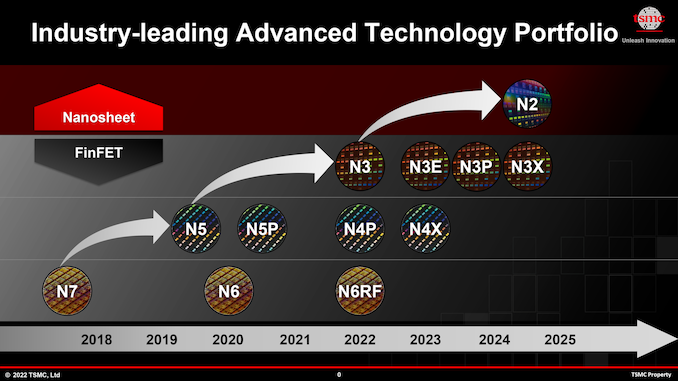
When TSMC initially introduced its N2 (2 nm class) process technology earlier this month, the company outlined how the new node would be built on the back of two new cutting-edge fab techniques: gate-all-around transistors, and backside power rails. But, as we've since learned from last week's EU symposium, TSMC's plans are a bit more nuanced than first announced. Unlike some of their rivals, TSMC will not be implementing both technologies in the initial version of their N2 node. Instead, the first iteration of N2 will only be implementing gate-all-around transistors, with backside power delivery to come with a later version of the node.

So far, TSMC has mentioned two distinctive features of N2: nano sheet gate-all-around (GAA) transistors, and backside power rails. GAA transistors have two unique advantages over FinFETs: they solve many challenges associated with the leakage current since GAAFET's channels are horizontal and are surrounded by gates around all four sides. Meanwhile, backside power rail enabled improved power delivery to transistors, which increases performance and lowers power consumption.

But, as it turns out, TSMC is not planning to start with both nanosheet GAA transistors and backside power rails in the initial generation of its N2 process technology. As disclosed by the company last week at their EU symposium, the first generation of N2 will only feature gate-all-around transistors. Backside power delivery, on the other hand, will come later with more advanced implementations of N2.

At this point the company hasn't said too much as to why they're not rolling out backside power delivery as part of their initial N2 node. But, in discussing the bifurcation, TSMC has noted that backside power delivery will ultimately add additional process steps, which the company is seemingly looking to avoid on their first try with GAAFETs.

The lack of backside power delivery in the original version of the N2 fabrication technology perhaps explains rather moderate performance improvement of N2 when compared to N3E node. While for high-performance computing (CPUs, accelerators, etc.) a 10% to 15% performance improvement at the same power and complexity does not seem to be impressive, a 25% to 30% power drop at the same speed and complexity seems to be very good for mobile applications. 

Advertised PPA Improvements of New Process Technologies
Data announced during conference calls, events, press briefings and press releases
  TSMC
N5
vs
N7
N3
vs
N5
N3E
vs
N5
N2
vs
N3E
Power -30% -25-30% -34% -25-30%
Performance +15% +10-15% +18% +10-15%
Chip Density* ? ? ~1.3X >1.1X
Volume
Manufacturing
Q2 2022 H2 2022 Q2/Q3 2023 H2 2025

*Chip density published by TSMC reflects 'mixed' chip density consisting of 50% logic, 30% SRAM, and 20% analog. 

Considering that TSMC always offers multiple versions of its nodes, that TSMC has several variants planned for N2 is not all that surprising. Nonetheless, it is a bit odd to see that TSMC is taking a rather long road to backside power delivery.

Compared and contrasted to the competition, this will end up being a notable difference from how rival Intel is planning to handle their own GAAFET/backside power transition with the Intel 20A process. Intel intends to introduce its GAA RibbonFET transistors and PowerVia interconnects together in mid-2024 – going so far as to create an internal pseudo node just to focus on RibbonFET development. TSMC, on the other hand, is taking a more cautious approach to risks and innovations, one which potentially has TSMC moving at a slower pace, but is also an approach that has traditionally been a better fit for TSMC's need to deliver more constant and consistent updates to its fab offerings.

And while we're still a few years out, it will be interesting to see what this means for the competitiveness of TSMC's first-generation N2 node. Will a GAAFET process without backside power delivery be at a meaningful disadvantage? Per current schedules, we'll find out the answer to that in the second half of 2025, when TSMC's first N2 node is slated to enter high-volume manufacturing (HVM).


from AnandTech https://ift.tt/5N9cbEy

TSMC to Customers: It's Time to Stop Using Older Nodes and Move to 28nm

We tend to discuss leading-edge nodes and the most advanced chips made using them, but there are thousands of chip designs developed years ago that are made using what are now mature process technologies that are still widely employed by the industry. On the execution side of matters, those chips still do their jobs as perfectly as the day the first chip was fabbed which is why product manufacturers keep building more and more using them. But on the manufacturing side of matters there's a hard bottleneck to further growth: all of the capacity for old nodes that will ever be built has been built – and they won't be building any more. As a result, TSMC has recently begun strongly encouraging its customers on its oldest (and least dense) nodes to migrate some of their mature designs to its 28 nm-class process technologies.

Nowadays TSMC earns around 25% of its revenue by making hundreds of millions of chips using 40 nm and larger nodes. For other foundries, the share of revenue earned on mature process technologies is higher: UMC gets 80% of its revenue on 40 nm higher nodes, whereas 81.4% of SMIC's revenue come from outdated processes. Mature nodes are cheap, have high yields, and offer sufficient performance for simplistic devices like power management ICs (PMICs). But the cheap wafer prices for these nodes comes from the fact that they were once, long ago, leading-edge nodes themselves, and that their construction costs were paid off by the high prices that a cutting-edge process can fetch. Which is to say that there isn't the profitability (or even the equipment) to build new capacity for such old nodes.

This is why TSMC's plan to expand production capacity for mature and specialized nodes by 50% is focused on 28nm-capable fabs. As the final (viable) generation of TSMC's classic, pre-FinFET manufacturing processes, 28nm is being positioned as the new sweet spot for producing simple, low-cost chips. And, in an effort to consolidate production of these chips around fewer and more widely available/expandable production lines, TSMC would like to get customers using old nodes on to the 28nm generation.

"We are not currently [expanding capacity for] the 40 nm node" said Kevin Zhang, senior vice president of business development at TSMC. "You build a fab, fab will not come online [until] two year or three years from now. So, you really need to think about where the future product is going, not where the product is today."

While TSMC's 28nm nodes are still subject to the same general cost trends as chip fabs on the whole – in that they're more complex and expensive on a per-wafer basis than even older nodes – TSMC is looking to convert customers over to 28nm by balancing that out against the much greater number of chips per wafer the smaller node affords. Therefore, while companies will have to pay more, they also stand to to get more in terms of total chips. And none of this takes into account potential ancillary benefits of a newer node, such as reduced power consumption and potentially greater clockspeed (performance) headroom.

"So, lots of customers' product today is at, let's say 40 nm or even older, 65 nm," said Zhang.  They are moving to lower advance nodes. 20/28 nm is going to be a very important node to support future specialty. […] We are working with customer to accelerate [their transition]. […] I think the customer going to get a benefit, economic benefit, scaling benefit, you have a better power consumption.  but they've already got a chip that works. Why? Oh, then you could say why we do advanced technology. Yeah. Yeah. I mean, it's, uh, find just the nature of the summit is you go to a next node, you get a better performance and better power and overall you get a system level benefit."

In addition to multiple 28nm nodes designed for various client applications, TSMC is expanding its lineup of specialty 28nm and 22nm (22ULP, 22ULL) process technologies to address a variety of chip types that currently rely on various outdated technologies. As with the overall shift to 28nm, TSMC is looking to corral customers into using the newer, higher density process nodes. And, if not 28nm/22nm, then customers also have the option of transitioning into even more capable FinFET-based nodes, which are part of TSMC's N16/N12 family (e.g., N12e for IoT). 


from AnandTech https://ift.tt/nPu50Q8